


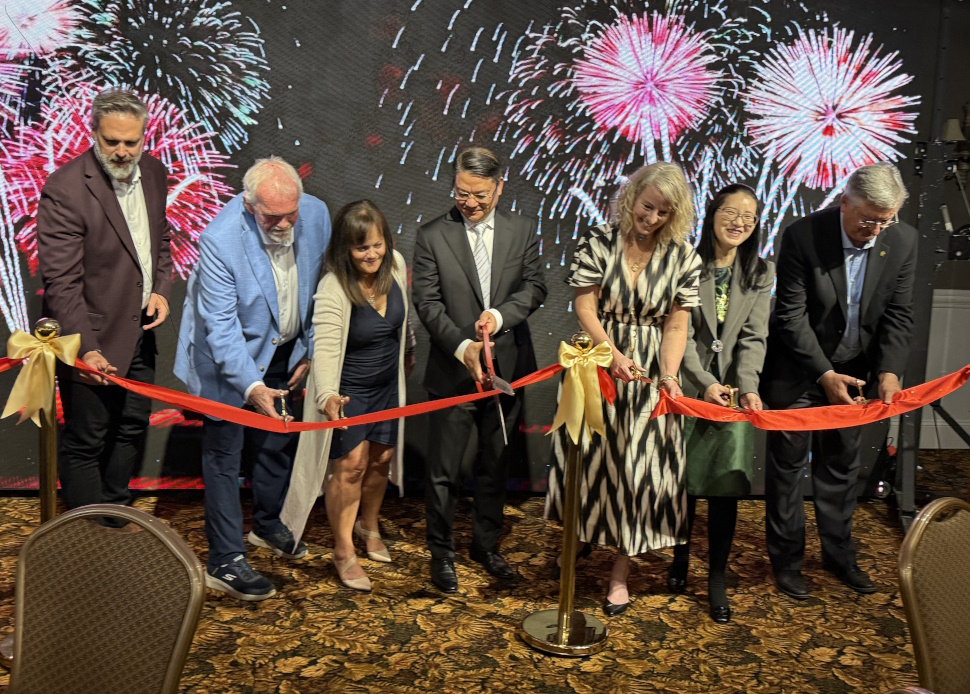
Carpere held an event at Grant Hall on Thursday to unveil its plans for an AI (artificial intelligence) health and wellness centre at the former Valley View site.
The first phase of the plan is to repurpose more than 325,000 square feet of existing buildings to create AI data centres, a new health and wellness centre, and greenhouses.
“Moose Jaw has a rich Chinese-Canadian history and it makes my connection to this city even stronger. Of all the places we could have ended up, I believe fate brought us here,” said Chris Yuan, CEO of the project.
The total investment in the project is expected to be around $400 million.
The Valley View Centre, built in 1955, housed individuals with intellectual disabilities. The site included residences, a hospital, tree nursery, garden, kitchen, bakery, laundry, shops, a theatre, a school, and, in 1966, a swimming pool was added.
“It very much operated as a small, modern community within Moose Jaw,” said Alan Wallace of Wallace Insights, who has been helping design the concept plan with Carpere.
Valley View closed its doors in 2019, and Carpere purchased the property from the province in September 2020.
The site includes 150.5 acres of developable land, of which Carpere plans to develop 100 acres.
With the site adjacent to Wakamow Valley, Wallace said not diminishing the valley remains a top priority. The plan includes enhancing green spaces, restoring the top of the riverbank with natural vegetation, and linking to the existing trail system.
The site features more than 350,000 square feet of existing buildings and 1.3 kilometres of internal roadways.
Wallace called the project an “ambitious” but “realistic” plan for repurposing the site.
The focus over the next three to four years, according to Wallace, is to renovate and reuse the existing vacant buildings.
“These buildings are very substantial in size. They are very substantial in their construction. They were built to last,” Wallace said.
He added that Carpere wants to first establish employment uses on the site to generate revenue, increase site security due to vandalism issues, and leverage the advantage of the existing infrastructure.

The project is expected to employ between 50 and 75 people, with the first phase utilizing about 25 acres.
The development will proceed in four phases.
Phase 1 involves renovating and converting the former residential buildings on the north end of the property—approximately 90,000 square feet—into a new health centre, regenerative medicine hospital, nursing training school, home care service institution and AI data centre. Renovations are slated to begin later this year and wrap up in 2027.
Also part of Phase 1 is converting a smaller 9,000-square-foot former workshop into an AI data centre.
Phase 2 will focus on renovating the former administration and hospital buildings, along with the former kitchen and dining area—about 90,000 square feet in total. These buildings will house new greenhouses and AI data centres. Construction is expected to take place between 2025 and 2028.
Phase 3 will refurbish the former laundry, maintenance and storage building to accommodate another AI data centre, also between 2025 and 2028.
Phase 4 includes constructing a new AI data centre. The size and location of this building are still to be determined.
The development will require significant power to operate the AI data centres—starting at 15 megawatts and potentially growing to 150 megawatts.
Project manager Adrian Lai said it is an ambitious project, and they are working closely with SaskPower.
“It’s a large project with fairly substantial investments required, and so we are looking forward to working with different levels of government. Power is a big part of this. We are working closely with SaskPower to be able to have the energy required to power all these data centres. As you know, it is fairly power-hungry,” Lai said.
The data centres will also generate a large amount of heat, with 35 per cent of the budget allocated to cooling. Wallace said the hope is to capture the heat generated by the data centres and use it to support the greenhouses.
The next step is for Carpere to submit a formal application to the city to amend the concept plan.
A concept plan was presented to city council and rezoning completed in 2023. However, that concept focused more on residential development with a public plaza and market.
Wallace said they are working with city administration on a zoning amendment to accommodate the AI data centres. If approved by council, public notices would be issued, and a public hearing would likely be held in September.
The remaining acres of the site will include open green space. About 73 acres are still to be determined, but Wallace didn’t rule out future residential development overlooking the Moose Jaw River.
link