


Remote patient monitoring (RPM) facilities are vital for countries having a large geographical areas and dense population. RPM facilities are even more crucial for nations with limited medical personnel. In the past few years, RPM facilities in India has gained significant growth due to growing healthcare needs, large demographic area and growing elderly population. Another reason contributing to significant attention in remote patient monitoring is due to large volume of population lives in rural areas where healthcare facilities are often inadequate. Such geographical barriers can be easily overcome by use of RPM which allows doctors to monitor patients in rural and remote locations without travelling1. Thus, RPM reduces both time and cost and brings virtual presence of a doctor to remote areas2. In India large volume of patients are suffering from hypertension, respiratory disorders, diabetes and cardiovascular diseases. RPM can help such patients through continuous monitoring and prevent complications and restrict the disease for progressing. In nations having dense population, hospitals are overcrowded and introducing RPM facilities can reduce unnecessary hospital visits to ease the pressure on medical staff and healthcare facilities. This would also minimize the risk of spreading infection as witnessed during the COVID-192.
Remote patient monitoring is blissful for remote patients as they can manage their health conditions from home, reducing out-of-pocket expenses for travel and hospitalization3. This is very significant for poor patients who pays for healthcare out-of-pocket. As stated earlier, RPM is even more blissful for elderly patients as they can receive continuous health monitoring at home. Thus, RPM also resolves the issue of limited mobility4. The technological advancements such as smartphone penetration, digital health technologies, high speed Internet are also contributing into the growth of RPM.
During COVID-19 healthcare professionals highlighted the need of RPM as it offers limited physical contact and provides an environment where patient monitoring is possible in quarantine or isolation5. Government initiatives like the Ayushman Bharat Digital Mission and telemedicine guidelines have set the stage for widespread adoption of digital health and RPM solutions in India. These policies are encouraging the integration of digital tools to bridge healthcare gaps.
Due to RPM the collection of continuous patient health data is made possible. Such data is significant as it can provide insights into population health trends when analyzed properly6. This approach of data analyses leads to predictive health management and policy making. Another key benefit of RPM is it ensures monitoring in a real time and thus leading to timely intervention. RPM can help reduce complications and improve patient health particularly for patients having chronic disease which demands constant care.
The most critical thing in RPM is maintaining privacy because sensitive health information is continuously collected and stored electronically6. Ensuring privacy is essential due to legal, ethical and security considerations. Storing patient health data includes basic health information, complete medical history, medications and real time health metrics. Revealing such data to unauthorized person can lead to identity theft, discrimination, or stigmatization of patients. Thus, privacy preservation is crucial to protect them from any harm and preserves their dignity. Moreover, highly secure RPM systems can significantly encourage patients to adopt RPM technologies. If patients are not confident that their data is handled securely and privately, they may be reluctant to participate in RPM programs, limiting the effectiveness of the technology.
Several countries, including India, the patients health data is protected by laws and regulations. These regulations mandate strict privacy standards. For example, India and United States ensure data privacy through Personal Data Protection Bill and Health Insurance Portability and Accountability Act (HIPAA) respectively7. Non-compliance with these regulations can lead to legal penalties and damage the reputation of healthcare organizations. Moreover, RPM systems are highly dependent on cloud storage and mobile applications and thus making them susceptible to cyberattacks such as hacking, phishing, or ransomware. So, it is crucial to maintain patient data by introducing highly secure encryption techniques. Compromising such data can lead to stress and anxiety among the patients. Thus, privacy is essential to prevent stigmatization or emotional distress.
Blockchain technology can significantly enhance the privacy and security of patient data in remote patient monitoring (RPM) by providing decentralized, transparent, and tamper-proof systems6,8. It is seen that traditional digital healthcare systems were relying on centralized servers which makes the whole system vulnerable to breaches or attacks. The blockchain technology works on decentralized system where data is distributed across multiple nodes and thus avoids single point of failure. Due to this decentralized behavior it even more difficult for hackers to compromise patient data. Maintaining patient data on blockchain is highly secure as data is not kept in plain text. In fact, data is encrypted using advanced cryptographic methods9. Only authorized parties with the correct cryptographic keys can access and decrypt this data, ensuring that even if the data is intercepted, it remains unreadable.
Blockchain offers an immutable ledger which means once data is recorded it cannot be altered or deleted without consensus. During the consensus process all nodes in the network participate and take decision mutually10. A hacker must breach at least 51% of the nodes of the entire network to change the decision during the consensus process. This immutability guarantees that patient records are tamper-proof, preventing unauthorized changes that could compromise data integrity or privacy. Apart from the privacy, the blockchain system may allow patient centric environment where patient can decide who can have access to data. In such environment, patient can grant and revoke access to healthcare providers, researchers, or insurance companies. This ensures that only authorized individuals can view or modify their medical data. Blockchain maintains log of every action and thus can provide a complete detail of who accessed the data, when, and for what purpose. This ensures accountability and reduces the risk of unauthorized data access.
Blockchain technology offers a mechanism for anonymizing or pseudonymizing patient data. pseudonymous identities ensure to preserve sensitive information securely and allows data sharing with third parties without revealing the identity of the patient. To automate privacy policies and permissions, smart contracts can be deployed on the blockchain11. For example, a smart contract can be programmed to automatically grant access to a specific healthcare provider when certain conditions are met and then revoke that access once it’s no longer needed. Blockchain based healthcare systems are highly resistant to Distributed Denial of Service (DDoS) attacks, which can disrupt traditional non blockchain based healthcare data systems. Since RPM systems rely on the continuous flow of data, blockchain’s security ensures uninterrupted service while protecting patient data from malicious disruptions.
Most of the studies dealing with blockchain and remote patient monitoring do not deal with patient medical reports6,12,13. There are several reasons why blockchain and remote patient monitoring (RPM) studies typically do not focus on storing complete medical reports directly on the blockchain. While blockchain offers excellent privacy, security, and transparency, there are technical and practical limitations that make it less suitable for directly storing large volumes of sensitive medical data, such as detailed medical reports. Most blockchains have limited storage capacity because they are designed to handle small-sized, transactional data, such as logs of actions, timestamps, and metadata. Medical reports, imaging files (e.g., X-rays, MRI scans), and large datasets associated with remote patient monitoring can be quite large, making blockchain an inefficient and expensive option for storing this data13. As the volume of data grows, storing large medical records on-chain would lead to scalability problems, increasing the size of the blockchain significantly. This would slow down network performance and increase the cost of operating the blockchain.
Medical reports often contain highly sensitive information that patients might not want to be exposed or made accessible, even indirectly. Blockchain’s transparency, which is one of its strengths, could also be a potential drawback in healthcare if not properly managed. Although encryption can safeguard data, storing the data on-chain increases the complexity of ensuring that only authorized individuals can decrypt and access it. Storing data on blockchain is expensive, especially in public blockchain networks where fees are tied to data size. As medical reports often include detailed documents, images, and multimedia content, the cost of directly storing these on a blockchain could be prohibitive, particularly when dealing with large patient populations. Thus, integration of blockchain and internet of things is crucial for remote patient monitoring environment.
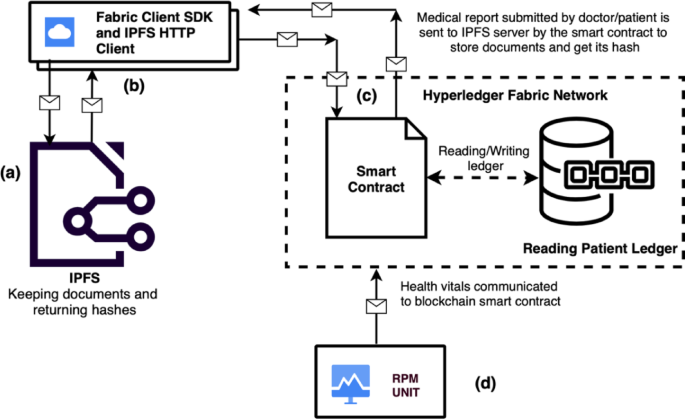
The major contribution of this work can be summarized as follows: First, we disclose the present state of the art with context to blockchain in healthcare sector. Second, we demonstrate the technique to store both medical reports and patient health parameters coming from IoT (Internet of Things) sensors on the blockchain network in such a way which do not slow down the network performance. Third, we demonstrate how to evaluate overall performance in terms of throughput and latency of such systems at different transaction rates.
link