A scientometric analysis on blockchain and NFTs: trends and development
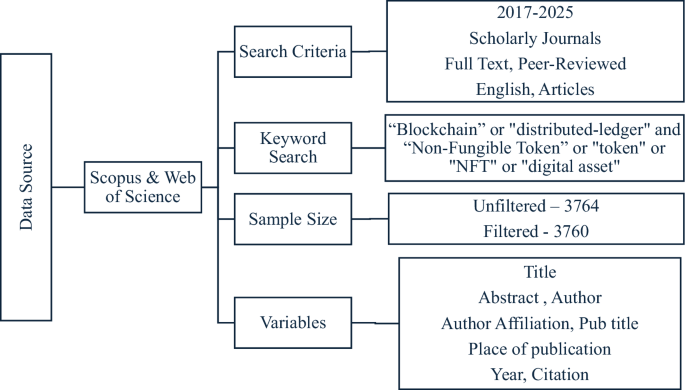
Wordcloud pertaining to NFTs and Blockchain
The Wordcloud in Fig. 3 depicts the most commonly used terms associated with blockchain and NFTs over the years. By examining data from 2017 to 2025, a period of more than seven years, we can identify trends in the frequency of these terms. The 2017 Wordcloud, for example, showcases terms such as blockchain, energy, tokens, chains, PKI (Public key infrastructure), and Decentralized Autonomous Organization (DAO). Similarly, 2018 introduces new domains, such as smart networks, bitcoin, digital contracts, technology, and tokens. Likewise, 2019 introduces concepts and industries related to smart contracts, security, digital platforms, Ethereum, and cryptocurrency. Similarly, 2020 underscores the importance of users, the IOT, and the concept of decentralization. The 2024 Wordcloud further highlights terms related to fungible, metaverse, privacy, and NFT. By combining data from 2017 to 2025, Wordcloud reveals a comprehensive range of terms, categories, and industries associated with blockchain technology. Examples include blockchain, digital contracts, security, decentralization, authentication, and market trust. According to the Wordcloud findings covering the years 2017 through 2025, the terms that appear most frequently in relation to blockchain and NFTs are revealed. The content of this piece sheds light on the multifaceted and ever-evolving conversation surrounding blockchain technology and NFTs, which encompasses aspects of technology, security, money, digital rights, and decentralization. The image shows a strong and growing innovation ecosystem, which emphasizes the potential for new lines of research in the domains of trust mechanisms, smart contract development, and tokenized economies.
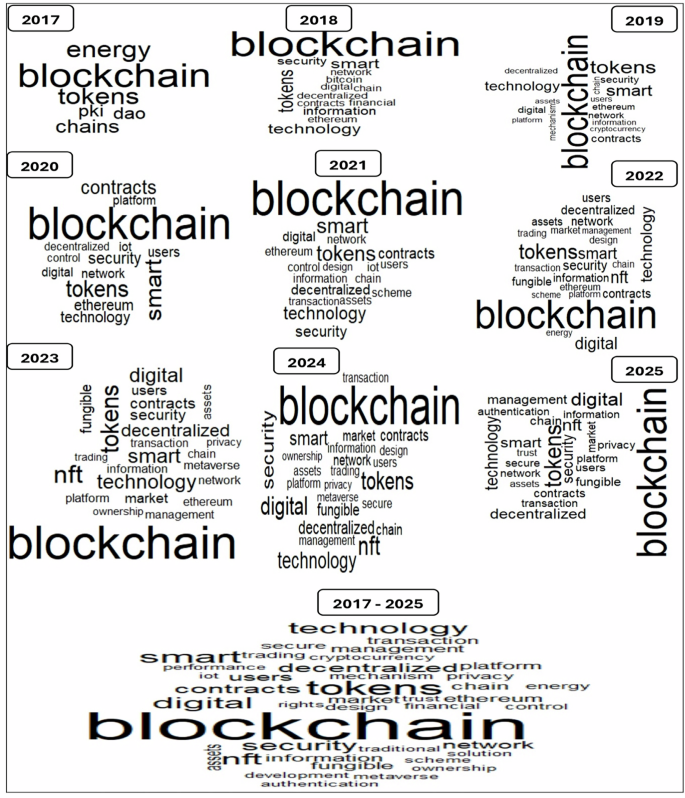
Wordcloud around Blockchain and NFTs.
Correlation graph around blockchain and NFTs
Figure 4 illustrates the correlations between various terms. This chart clearly illustrates intricate relationships between themes concerning technology, finance, and ethics. The main themes areprobably issues of sovereignty for AI or decentralized platforms, financial integrity, and rights for data. The graph prominently positions the term “sovereign,” potentially serving as its central focus. It is significantly associated with or fundamental to numerous other concepts, including “intelligence,” “artificial,” and “reserved.” These phrases may suggest dialogs concerning “sovereignty” in situations, such as AI, autonomy, or governance. The terms “data” and “rights/lefts” may signify dialogs over data ownership, political divisions, or ethical rights in technology. “Finance,” “fault,” and “tolerance” may pertain to financial systems, mistake management, or resilience. The terms “scam” and “rug” may indicate fraudulent behaviors, potentially within blockchain or financial contexts, with “rug pull” being a prevalent scam in cryptocurrency. It indicates a critical perspective on financial systems, potentially emphasizing weaknesses or fraudulent activities. The correlation chart showing the intersection of AI, data, finance, and blockchain clearly indicates that the relationship of these elements has reshaped our concept of autonomy and governance. The data ownership prompts instantaneous queries in the form of political divergence and moral rights, making us question who actually benefits from technological advancements. The equilibrium between fault and tolerance in economic systems reveals vulnerabilities that are open to exploitation, leading to an upsurge in scams and thefts that destroy confidence. Examination of these economic frameworks reveals underlying flaws that must be watched out for and altered. Finally, with the potential of using AI and blockchain, a proper understanding of their implications is critical for creating an even more democratic and secure economic future.

Correlation between different words using connecting lines.
TF-IDF around blockchain and NFTs
The TF-IDF graphs showcase (Fig. 5) the least frequently used terms associated with the keywords under investigation, revealing areas of research that have received less attention. Using the TF-IDF method, these graphs show the unique terms that are not commonly found in the documents, pointing out possible areas where research is lacking. While the TF-IDF graphs typically generate separate charts for each year, the current representation presents all years combined. The graphs feature a range of terms that have appeared infrequently in the context of blockchain and NFTs, such as Libra, Aadhar, plastic, scam, rice, brokerfi, cleaning, stamps, Jala, brownie, and Frax. Terms such as “plastic,” “rice,” “cleaning,” and “stamps” indicate uncommon connections between blockchain and diverse businesses, as blockchain extends its reach beyond banking into logistics, agriculture, and cultural assets (Toader et al., 2024). These terms represent areas that could benefit from further exploration and research within the blockchain and NFT domains. NFTs and blockchain technology unveil a complex network of possibilities that go far beyond conventional financial frameworks. By using terms like Libra, Aadhar, and brokerfi, the discussion of blockchain is able to cover a wide range of sectors, including logistics, agricultural, and even cultural assets. The range of applications illustrates how blockchain has the potential to completely transform our understanding of value and ownership in a variety of industries. However, further study is required to overcome the complexity and optimize the benefits of these cutting-edge technologies in order to effectively utilize these advances, whether they are in cleaning services or agricultural supply chains. Our knowledge will grow as we investigate this changing environment, opening the door for a time when blockchain technology and NFTs will be able to effectively redefine connections across a wide range of fields.

Least occurring words around keywords.
Topic modeling via LDA around blockchain and NFTs
Latent Dirichlet Allocation (LDA) graphs are primarily used for topic modeling, which involves identifying and visualizing the underlying themes or topics within a collection of documents. This graph (Fig. 6) effectively represents the distribution of words across different topics.

Blockchain and market trading
Several businesses, notably the energy industry, are utilizing blockchain technology. The goal of a research study called the Crypto-Trading Project is to encourage smart grids in the Sardinia Region by utilizing smart contract capability. The project will expand bitcoin trading functionalities to the renewable energy sector by implementing a modular blockchain-based software platform that includes a robo-advisor. Such an initiative might strengthen both the local economy and the output of renewable energy. (Esmat et al., 2021; Li et al., 2023)
Digital tokens and financial technology
Private digital token offerings on Ethereum have increased since the first virtual currency was introduced on Bitcoin in 2009. Digital currencies are being considered by governments as an addition to cash. Big businesses that have made significant investments in blockchain technology include Walt Disney, Oracle, American Express, IBM, Toyota, JP Morgan Chase, Goldman Sachs, and Facebook. Another well-liked use of blockchain technology is crowdfunding, yet legal concerns are still unclear (Thetlek et al., 2023). Legal questions concerning the assignment of intangibles are brought up by the emergence of new payment media, such as pre-funded gift cards or digital tokens. This essay examines these systems and presents a legal theory that supports their use as a unique method for transferring money between system operators and deposits (QC, 2019).
Blockchain and cryptocurrency networks
Decentralized systems, such as P2P networks for cryptocurrencies like Bitcoin, disseminate system knowledge. These networks tackle problems that already exist while posing new ones. When paired with other distributed scenarios, they produce outstanding resilience and security, opening new study avenues in the realm of peer-to-peer cryptocurrency networks. (Cristina et al., 2025; Biais et al., 2023)
Metaverse development and virtual tokens
Play-to-earn games and metaverses with their economy, trade, and currencies—the metaverse and play-to-earn tokens—are the result of the marriage of blockchain technology with the gaming sector (Musamih et al., 2024; Vidal-Tomás (2022); Wyczik, 2024).
Blockchain security and legal network
The 2009 ascent of Bitcoin sparked the development of blockchain technology, which is currently being investigated for use in financial assets such as derivative contracts and securities. The conceptual foundation for blockchain network governance in financial markets is presented in this article, with an emphasis on private law and financial regulation to safeguard both society and market players (Paech, 2017; Moubarak et al., (2018); Li, 2024).
Energy trade and blockchain
As renewable energy resources expand quickly, energy trading is moving from centralized to distributed systems, and blockchain technology is becoming increasingly used in this process. However, problems like poor performance, expensive transactions, and privacy and security breaches still exist. This survey looks at blockchain-based energy trading inside the electrical power grid, categorizing current schemes into three groups and finding obstacles. The goal of future research is to enhance the security assessment methodology and system architecture (Yousaf et al., 2022; Esmat et al., 2021; Karumba et al., 2023).
Authentication and the IoT
With billions of devices connected, the IoT opens new possibilities for wearables, smart cities, smart homes, and e-health applications. Security is critical since rogue devices might cause damage to IoT systems. This study offers a revised perspective on IoT authentication by summarizing several protocols and using a multi-criteria classification to assess their merits and demerits. This is an important beginning step for developers and researchers (Ahmed et al., 2022; Ferrag et al., 2017; Kumar et al., 2022).
Authors related Information around Blockchain and NFTs
The Wordcloud visualizations showcase (Fig. 7) the authors who have published the most research related to blockchain and NFTs. These authors, including Zhang, Wang, Liu, Chen, Yang, Xu, Kumar, Sharma, Zheng, Huang, Kim, Gupta, Khan, Salah, and Jayaraman, have made major contributions to the discipline. Additionally, the correlation graphs reveal collaborative research efforts among these authors, indicating that they are often working together to improve our knowledge regarding blockchain and NFTs. This collaborative approach is essential for addressing the complex challenges and opportunities presented by these emerging technologies. The additional figure offers helpful details about the geographical distribution of research on blockchain and NFTs. It reveals that China is at the forefront of research in this domain, followed by India, Germany, Italy, Singapore, Switzerland, and Japan. This study highlights the global nature of blockchain and NFT research and the collaborative efforts being undertaken across different countries. Furthermore, the graphs depicting annual publication trends indicate a significant increase in research output over time. In 2017, merely 7 publications were documented, signifying the commencement of the observed era characterized by low academic or research engagement. By 2018, the quantity had escalated significantly to 87 publications, signifying a heightened interest or augmented engagement in the relevant topic. The growing trend persisted with 205 articles in 2019, subsequently rising to 298 publications in 2020. The momentum continued in 2021, with 370 articles, indicating a consistent increase in scientific output. We note a significant increase in 2022, with the figure reaching 599, approximately twice the production of 2020. The growth trend persisted robustly in 2023 with 919 articles, and it reached its zenith in 2024 with 947 publications and in 2025 with 275 publications till June 3. This pattern suggests a rapid expansion of research activity due to rising academic interest.

Authors related information.
Table 2 provides a detailed breakdown of the institutions contributing the most research on blockchain and NFTs. The Institute of Electrical and Electronics Engineers Inc. (IEEE) stands out as the leading publisher, with an impressive 1079 papers published. Following closely behind are Springer Science and Business Media Deutschland GmbH (371 papers), Association for Computing Machinery (223), MDPI (157 papers), and Elsevier (121 papers). This list emphasizes the prominent position these institutions hold in contributing to blockchain and NFT research. Also, the table displaying paper counts on a publication title basis offers valuable information regarding the particular outlets where researchers are publishing their work. This data can prove valuable to identify major conferences and journals within the blockchain and NFT research base. The concerted efforts of organizations such as Business Media Deutschland GmbH, the Association for Computing Machinery, MDPI, and Elsevier have significant impacts on the landscape of blockchain and NFT research. Their work not only adds to the knowledge base in this fast-developing area but also identifies specific channels for sharing significant research findings. Analyzing title-wise paper quantities gives useful insight into the journals and conferences most central for researchers looking to disseminate their work effectively. By understanding these dynamics, scholars can strategically navigate the confusing ecosystem of blockchain and NFT research, ensuring that their contributions reach the appropriate audience and fostering further innovation in this transformative area.
Citation analysis around blockchain and NFTs
Tables 3–7 present the results of citation analyses within the dataset, presumably pertaining to Blockchain and NFTs from 2017 onwards. The document authored by Turkanović (2018) stands out as the most cited, garnering 515 citations, trailed by Adhami (2018) with 387 citations, and Makhdoom (2020) with 368 citations. While multiple authors are credited, the citation count reflects the cumulative impact of their collaborative efforts. For instance, Momtaz, Paul’s team collectively received 618 citations, followed by Zheng, Zibin with 363 citations and Salah, Khaled with 277 citations. Analysis of the data indicates that the United States holds the highest overall citation count (9135), followed by the China (7247) and United Kingdom (4105). Notably, the Faculty of Nanyang Technological University – NTU Singapore, takes the lead with 268 citations, followed by the Tsinghua University, Beijing, China with 213 citations, and the Khalifa University of Science and Technology, UAE with 161 citations. In the realm of blockchain and NFTs, the most cited source or journal is IEEE Access, with 1894 citations, followed by Lecture Notes in Computer Science with 945 citations and IEEE IoT Journal with 538 citations.
link