Bangkok Post – Narit upgrades Chalawan to Astronomical Digital Technology and AI Applications Laboratory
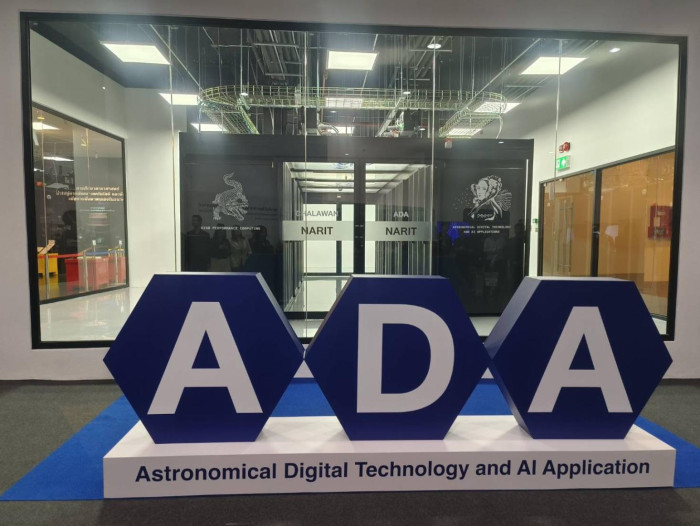
The National Institute of Astronomical Research of Thailand (Narit) has upgraded its Chalawan high-performance computing system into the Astronomical Digital Technology and AI Applications (ADA) Laboratory, aiming to cultivate a new generation of AI-driven space research.
The move will also position Thailand as a regional leader in advanced technology, strengthen its competitiveness in frontier science, and support real-world problem-solving.
“Our high performance computing system has become a cornerstone for researchers and students to expand their expertise and pioneer new discoveries,” said Wiphu Rujopakarn, the institute’s executive director during the 10th anniversary year of the Chalawan infrastructure.
Supported by Thailand Science Research and Innovation, the ADA lab integrates the Chalawan system with cutting-edge AI.
The ADA Lab will transform vast amounts of cosmic data into actionable knowledge mainly in raising processing speeds for the national radio telescope 100-fold, allowing scientists to detect split-second astronomical phenomena instantly — a task that previously took weeks.
The infrastructure is available to external engineers and academics via the National e-Science Infrastructure Consortium.
The initiative aligns with the institute’s “ASTRONOMY+” strategy, which aims to translate astronomical innovation into practical tools that benefit Thai society.
The goal is to translate high-tech research into economic value, job creation, and solutions for modern global challenges such as health, quality of life, safety and sustainable economic growth, Mr Wiphu said.
COMMERCIAL GRADE TECH
This direction is in line with global developments to address climate change and natural disasters through early warning systems by integrating high performance computing power with PM2.5 air quality data and seismic monitoring to provide faster alerts, reducing the level of risk to life and property.
In the fields of advanced astronomical and space engineering, the initiative aims to develop commercial-grade technology prototypes and foster the growth of startups specialising in space technology, AI and the Internet of Things.
These efforts are designed to expand the domestic supply chain and generate high-skilled employment opportunities for the future, Mr Wiphu said.
“We are not just developing the fastest computer system; we are building an ‘intellectual infrastructure’ that will transform previously static data into a powerful force to truly drive the country forward in the digital era,” Mr Wiphu said.
Utane Sawangwit, acting manager of the Information Technology Center at Narit, said the ADA Lab, which cost 30 million baht, was specifically designed to support big data and AI.
The system is equipped with graphics processing units, enabling the efficient development and processing of large language models.
It is interconnected via a high-speed network facilitating the rapid and continuous transfer of multi-terabyte data between databases and processing units.
Narit has a roadmap for AI application across four key areas, including screening and analysing signals from space to discover new astronomical phenomena and knowledge.
It also includes autonomous operations by utilising AI to control telescope networks and schedule autonomous maintenance, thereby increasing observational efficiency.
The other areas include using AI to determine the level of PM2.5 and creating immersive astronomical learning experiences via intelligent AI systems, making astronomy more accessible.
Mr Utane added that Chalawan has transitioned from performing basic calculations to supporting complex AI and deep learning models.
“In the next 3-5 years we will start seeing more things made by Thais, equipment we built by ourselves, going up into space,” Mr Utane said.
“Chalawan is not merely a centre for calculation; it is a multiplier for human capital. It transforms raw data into degrees, publications and international standing. By enabling the processing of 200 terabyte datasets and complex AI models, it secures Thailand’s place in the future of global science,” he added.
Thitaphon Boonprasit, country managing director of Dell Technologies Thailand, said Narit is one instituation that has trusted Dell’s cluster technology for over 10 years.
“This underscores the importance of stable, long-term technology partnerships in facilitating continuous research and development.”
However, Mr Thitaphon added that there are several significant challenges, such as a global shortage of memory, data sovereignty and a critical demand for professionals who can bridge the gap between technical knowledge and practical data application.
link