
Distributed storage database system for motion data based on blockchain technology
Experimental design
(1) Experimental purpose: this article aims to evaluate the performance differences between blockchain technology oriented distributed storage database systems for motion data and traditional database systems in key indicators, to help understand the advantages and disadvantages of blockchain technology in the field of motion data storage and provide reference basis for system selection.
(2) Preparation of experimental environment: a distributed storage database system for motion data oriented towards blockchain technology is set, deploying traditional database systems, such as relational database or NoSQL (Not only Structured Query Language) database. The same hardware devices are configured, including servers, storage devices, and network environment.
(3) Data preparation: motion datasets are prepared, including different types of motion data, such as step count, heart rate, calories, and so on, and the datasets are input into blockchain technology oriented systems and traditional database systems to ensure data consistency.
(4) Selection of experimental indicators: appropriate indicators are selected for experimental evaluation, such as storage space utilization, storage speed, data integrity, data privacy protection, security, data query response time, etc.
Storage space utilization: the same motion dataset in blockchain technology oriented systems and traditional database systems is stored, and the storage space utilization of the two systems are calculated, compared, and analyzed.
Storage speed: data write operations are performed in blockchain technology oriented systems and traditional database systems, and the average latency of data write is measured, recording the results. Read operations are performed, and the average latency of data read is measured.
Data integrity: for the two systems, data integrity is verified by modifying part of the data set or simulating data tampering, and the ability of the two systems to protect data integrity is analyzed, including data validation, anti tampering measures, etc.
Data privacy protection: experimental cases are designed, including storage and query operations of sensitive data. The privacy protection capabilities of blockchain technology oriented systems and traditional database systems for sensitive data are evaluated, including encryption, anonymization, and other measures.
Security: simulating unauthorized access or attacks, the security performance of blockchain technology oriented systems and traditional database systems is evaluated, including evaluation of identity verification, access control, and attack prevention.
Data query response time: a series of query operations are designed, including simple and complex queries, involving different data fields and aggregation operations, and the response time of the two systems to queries is measured, compared, and analyzed.
(5) Experimental operation and data collection: various operations are performed in the experimental design, recording experimental data. For each experimental indicator, eight repeated experiments are conducted to obtain stable results.
(6) Data analysis and result evaluation: statistical analysis on experimental data is conducted to compare the performance differences between blockchain technology oriented systems and traditional database systems in each indicator. Analyzing the reasons for differences can consider factors such as system architecture, data processing methods, and algorithms. The advantages and disadvantages of the two systems based on the experimental results are evaluated, providing targeted optimization and selection suggestions.
Experimental results
After eight repeated experiments, the following experimental data was obtained:
Table 1 presents a comparative analysis of data storage efficiency. In blockchain technology oriented systems, the data storage efficiency was 91%, while in traditional database systems, the data storage efficiency was 81%. It can be seen that systems oriented towards blockchain technology had higher storage space utilization rates and effectively utilized storage space. Traditional database systems might have some space waste when storing data.

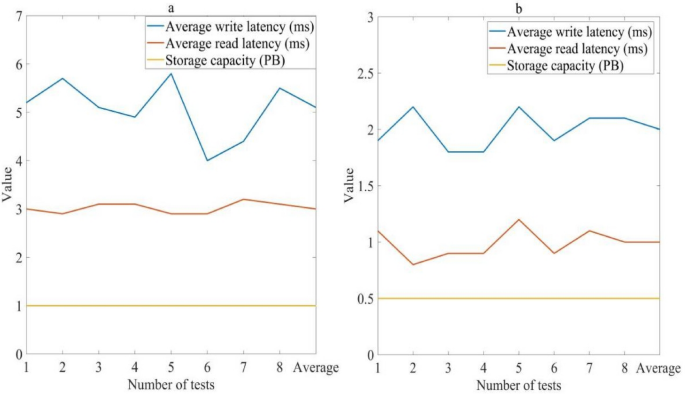
Comparison of storage speed. Figure 1(a) shows the system for blockchain technology. Figure 1(b) shows the traditional database system.
Figure 1 shows the comparison of storage speeds. Figure 1(a) shows a system oriented towards blockchain technology, and Fig. 1 (b) shows a traditional database system. In blockchain technology oriented systems, the average write latency was 5.1ms; the average read latency was 3.0ms; the storage capacity was 1 PB. In traditional database systems, the average write latency was 2.0ms; the average read latency was 1.0ms; the storage capacity was 0.5 PB. This indicated that systems oriented towards blockchain technology had relatively high write latency, while traditional database systems had lower write latency. Traditional database systems were able to write data to the database and read stored data more quickly. Systems oriented towards blockchain technology supported larger storage capacity and could handle larger scale motion data. Traditional database systems had smaller storage capacity and might not be able to meet the needs of large-scale data storage.

Comparison of data reliability Figure 2(a) shows the system for blockchain technology. Figure 2(b) shows the traditional database system.
Figure 2 compared the data reliability between blockchain-oriented and traditional database systems, showing that the former achieved 99.5% data integrity and 99.4% availability versus 97.7% and 97.3% in traditional systems, demonstrating superior resistance to tampering/damage and higher accessibility.
Table 2 further revealed blockchain systems employ advanced encryption/anonymization for privacy protection, offering stronger defense against unauthorized access and attacks compared to traditional databases with basic security measures.

Comparison of data access and query performance. Figure 3(a) shows the system for blockchain technology. Figure 3(b) shows the traditional database system.
Figure 3 showed the comparison of data access and query performance. Figure 3(a) showed the system oriented towards blockchain technology, and Fig. 3(b) showed the traditional database system. In blockchain technology oriented systems, the data write throughput was 1001 s, and the data read throughput was 2000s. In traditional database systems, the data write throughput was 500 s, and the data read throughput was 1501s. Systems oriented towards blockchain technology had higher data write throughput and could handle more concurrent write requests. Traditional database systems had lower write throughput and limited ability to handle concurrent writes. Systems oriented towards blockchain technology had higher data read throughput and could handle more concurrent read requests. Traditional database systems had lower read throughput and limited ability to handle concurrent reads.

Comparison of data query response time. Figure 4(a) shows the system for blockchain technology. Figure 4(b) shows the traditional database system.
Figure 4 showed the comparison of data query response times. Figure 4(a) showed a system oriented towards blockchain technology, and Fig. 4(b) showed a traditional database system. In blockchain technology oriented systems, the average Query response time was 5.0ms, and the complex Query response time was 8.1ms. In traditional database systems, the average Query response time was 9.9ms, and the complex Query response time was 15.3ms. Systems oriented towards blockchain technology had lower query response times and could respond faster to user query requests, while traditional database systems had higher average query response times.
It can be seen that the distributed storage database system for motion data oriented blockchain technology has certain advantages in certain aspects (such as storage capacity, data integrity, privacy protection, read latency, and query response time), but may not be as fast as traditional database systems in certain aspects (such as storage speed). It is necessary to weigh and choose based on specific application scenarios and requirements.
link