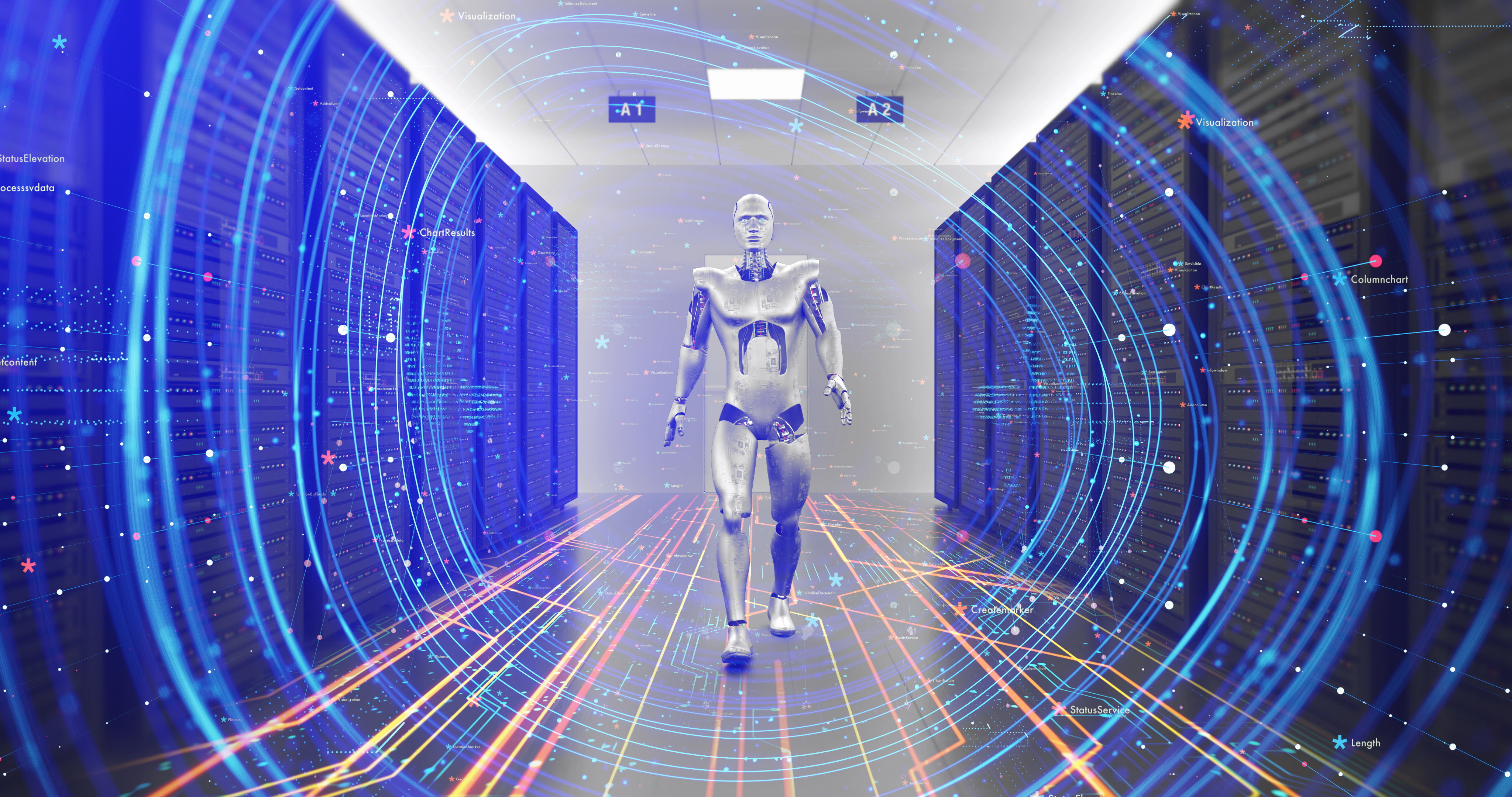
Do public servants need to be afraid of artificial intelligence?

Are the robots coming for public service jobs?
It’s a question public servants may be asking themselves with increased frequency as Prime Minister Mark Carney has signalled he wants to ramp up the use of artificial intelligence across the federal government.
Carney has included an AI minister in his cabinet, appointing former broadcaster Evan Solomon to the role.
The federal government also recently penned a memorandum of understanding with Canadian AI firm Cohere to explore deploying the technology more in government.
So how afraid should public servants be of AI taking their jobs? Here’s what you need to know.
Are public servants’ jobs at risk with AI?
A new report from the Dais, a public policy think tank based out of Toronto Metropolitan University, found that public sector workers have a higher “exposure” to AI than private sector ones. The report defined exposure as “the probability the occupation will have to interact with AI systems.”
The report found that the jobs of 74 per cent of public sector workers, including other levels of government, are exposed to AI, compared to 56 per cent of the overall workforce, largely due to the white-collar nature of public sector work.
In addition to measuring certain jobs’ exposure to AI, the Dais measured whether those jobs will have “complementarity” to the technology, or “whether usage of AI is more likely to assist the worker with common occupational tasks, instead of substituting for the worker and replacing those tasks.”
Jobs with high complementarity mean AI will assist workers in those occupations while those with low complementarity means artificial intelligence is more likely to replace them.
Federal public servants in particular have some of the highest exposure to AI job disruption. The report found 58 per cent of federal public servants are highly exposed to AI and have low complementarity, compared to 52 per cent in provincial and territorial governments and 31 per cent in municipal governments.
Why are some roles at risk and not others?
The report pointed to auditors, accountants, social policy researchers, administrative assistants and revenue officers as roles that are both highly exposed to AI and have lower complementarity.
The report also found that many public sector workers tend to perform routine cognitive tasks which AI is well positioned to substitute or replace.
“AI works where things are repeatable,” Keith Jansa, chief executive officer at the Digital Governance Council said in an interview with the Ottawa Citizen.
But that does not automatically mean that those jobs will be replaceable, said Jansa who added that “everything in a job isn’t all repetitive, and so there are functions where I just can’t see where you have AI as the de fact job, if you will.”
Viet Vu, one of the report’s authors, said the increased of AI in the government could mean fewer policy analysts and translators in the public service. He added that translators will likely have a smaller workload, but will still be relied upon for important legal documents.
“And so while we are seeing a lot more tasks in the policy analyst that AI can downright do, that doesn’t mean that you just replace all policy analysts with chatbots,” Vu said.
Should public servants be panicking about artificial intelligence?
Jansa said that an era of AI disruption is still in a distant future, and that it could take decades to happen.
The current “state of play” with AI adoption remains at the “experimentation” phase where workers and organizations are gaining familiarity with the technology, Jansa said.
Jansa likened the technology with the development of the automobile. It took decades for cars to become ubiquitous in North America, as car-specific infrastructure, such as gas stations and roads, were built.
“That transition spanned generations, not just a few years,” Jansa said.
Vu agreed that there is no need for public servants to panic. “AI should not be the reason why they feel anxious to go to bed,” he said.
Instead, public servants should see AI as a career development issue they’ll need to tackle, he added.
“To figure out whether our skills are getting stale or not, our knowledge is getting stale, or whether what we bring to the table continues to be relevant in a changing world,” Vu said.
“That concern, I think, has always been present, and that’s just the same level concern that, quite frankly, all public servants should generally feel about AI.”
In an emailed statement, Solomon, the AI minister, said that artificial intelligence “is a tool, as many technologies that have come before, that changes the way we function.”
Solomon compared AI to the advent of the internet in terms of the uncertainty that comes with a new technology.
“However, public servants play an undeniably crucial role, delivering expert advice, programs, and world-class service to Canadians,” he said. “AI can require upskilling and adaptation, and when implemented properly, will improve the way we serve Canadians.”
What happens next for AI in government?
In its report, the Dias recommended that public servants and their unions proactively plan for the AI transition.
If the necessary steps aren’t taken by the government, its employees and the unions that represent them, Vu said there could be labour strife. This may arise if workers feel like they haven’t been consulted, or if unions have not invested in understanding AI trends, said Vu. This could catch them “blindsided by any sort of conversation or changes announced,” Vu said.
“The reality is, unions have always tended to be at the forefront of a new piece of technology that actually impacts workers, to not only sort of set up appropriate safeguards for its workers in terms of working conditions and surveillance, but also to ensure that their workers can flourish in such an environment,” he added.
Vu said that there must also be a focus on talent retention instead of relying on consultants to deliver on AI. Vu said partnering with firms like Cohere is a positive step, but the government must also build in-house capacity to oversee the delivery of AI transformation.
And then there are the biases that experts say still plague AI.
Jansa said the technology needs more development to eradicate those biases, and that the structural adoption of AI is still lagging.
“There’s a need to restructure processes and to train workers and to justify the investment,” Jansa said.
Related
link