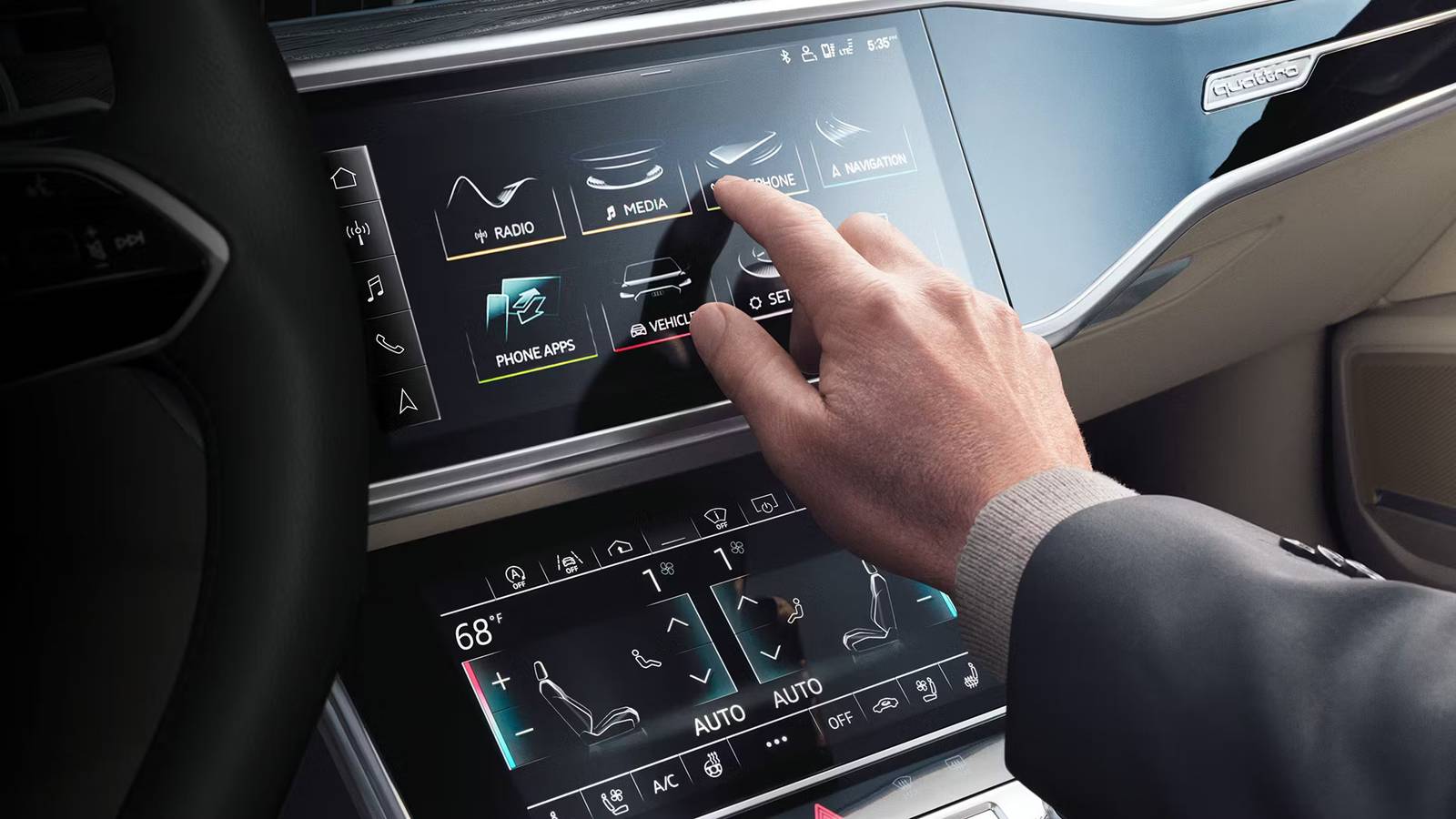
Finally, Automakers Are Turning Away From Capacitive Touch Buttons

For the most part, car technology has been evolving in a way that has made our lives easier and more comfortable. From keeping cool or warm depending on the season, to listening to music on a road trip, to cooking pizza on the go (yes, that really happened), automakers have come up with countless functions and features that have made our vehicles a better place to be.
There are some things, however, that have not quite caught on with drivers. Some features were hyped as the future of automotive technology, but ultimately fizzled out or became obsolete. Today we are focusing on capacitive touch buttons, which began to pop up on several models a few years ago, but have been widely criticized by drivers to the point where automakers have backtracked on their decision to implement them. Let’s take a look at these annoying buttons’ demise, and the consumer pushback that forced car companies to take a U-turn.
The Demise Of Capacitive Touch Buttons And The Pivot Back To Physical Controls

Capacitive touch buttons go hand in hand with their bigger cousin, the touchscreen, a device which has also been criticized as a potentially dangerous distraction for drivers. Although touchscreens do have their place in a world where infotainment systems are increasingly complex (and, crucially, are mostly used when the car is parked), capacitive touch buttons are a pointless and redundant replacement for a perfectly good device: the humble button, which can perform the same function while providing tactile feedback and without taking the driver’s eyes off the road.

Over the past couple of years, several automakers have begun to reconsider their decision to ditch physical controls, beginning to re-incorporate them in their upcoming models’ interiors. One of these brands is Alpine, whose head of design Antony Villain recently spoke to Autocar to express the company’s intention of prioritizing physical controls again. According to Villain, in a car where driving is the main focus, controls need to be instinctive. As touch-based controls go against that principle, requiring more effort and attention on the part of the driver, Alpine is moving away from them.
Hyundai is another brand that is making a similar move. Although its recent models use large amounts of tech, the analogue element is also given a space. The company spoke to Autocar back in April this year, confirming that physical buttons are here to stay in the interiors of all its models. Hyundai’s luxury sub-brand, Genesis, is going in that direction as well. Although the brand’s “Beauty of White Space” design principle prioritizes a minimalist approach, physical controls will still be integrated into the cabin alongside more high-tech features.
“We will maintain clutter-free interior designs while integrating key controls through AI and voice recognition. However, for safety and usability reasons, essential buttons will remain analog. The challenge will be to find the right approach to consolidate and streamline these physical controls.”
– Jaeho Oh, Genesis’ head of interior design
Consumer Pushback Against Capacitive Touch Buttons: The VW Lawsuit

Although many different automakers suffered from negative consumer feedback about capacitive touch buttons and excessive use of touchscreens, mostly in the form of people complaining on social media or word of mouth, one particular case stands out as it involved legal action. We’re talking about the recent class-action lawsuit involving Volkswagen, more specifically its all-electric ID.4 model.
Earlier this year plaintiffs Janice Beecher and Omar Hakkaoui, along with several other ID.4 drivers who joined the group, filed a lawsuit against Volkswagen in New Jersey. The main culprits have been identified as ID4s produced between 2021 and 2023, with the steering-mounted haptic controls being in the spotlight as a potentially dangerous feature. According to the lawsuit, “the Class Vehicles’ overly touch-sensitive capacitive steering wheels automatically engage Adaptive Cruise Control (“ACC”) with a mere light brush of the hand over the steering wheel’s haptic controls. This results in sudden and unintended acceleration while owners are driving the “Class Vehicle” (the “Class Vehicle” expression refers to the 2021-2023 ID.4).

The plaintiffs argue that the presence of the haptic controls should be considered a “defect” rather than a feature, as it has allegedly caused injuries and deaths through several accidents. The NHTSA record for the models in question does include reports of unintended acceleration, with the haptic controls being specifically labeled as dangerous in one complaint.
Not Just Buttons: Other Ways Automakers Are Replacing Touchscreens

Physical buttons and other controls may be a central part of automakers’ strategy for replacing capacitive touch buttons in response to consumer feedback, but they are not the only solution being employed. There is one other commonly used way of controlling an infotainment system which is, unfortunately, nearly as hated by drivers as the infamous touch buttons, although technology is rapidly improving. We’re talking about voice control, which has evolved in recent years thanks to the arrival of intelligent voice assistants and, later, AI-based features.

Although rudimentary voice-based functions had existed in some cars since the late 1990s, such as Mercedes-Benz’s Linguatronic system, Infiniti was the first automotive brand to implement something close to modern voice control technology on one of its models, the 2002 version of the Q45 luxury sedan. Over the course of the two decades that followed, more and more automakers began to implement voice-based features; the arrival of assistants like Alexa and Siri further accelerated this development. Voice control technology is now being explored as an alternative to both capacitive buttons and regular buttons, as improved voice functions can help drivers keep their eyes on the road and be less distracted while trying to control infotainment features.
Other Infotainment Features That Drivers Hate

Capacitive touch buttons are not the only automotive feature that has received extensive amounts of driver backlash in recent years. There are plenty of other aspects of the infotainment experience that have been the target of criticism, as vehicle owners call for automakers to make improvements. Last year, J.D. Power’s US Automotive Performance, Execution and Layout (APEAL) study put owner satisfaction under a microscope, analyzing how happy drivers were with the design and performance of their new cars. Here are some of the infotainment features that the study revealed to be major pain points.
Overly Complex Menus: Infotainment systems have grown more rich and complex over the years, with new features being constantly added. Unfortunately, this complexity has led to poor usability in some cases, with drivers reporting that reaching functions hidden beneath several layers of menus can be a source of frustration. Features like shortcut buttons help somewhat, but do not fully eliminate the problem.
Too Many Features: This point is very closely related to the previous one. The addition of more and more features does not just make the overall interface more complex; it also heaps unwanted and rarely used features onto the system. Most drivers only use a few core features of their infotainment system every day, and their experience can be negatively affected by simply having too much stuff available at their fingertips.

Audio-Related Issues: Music playing is one of the most frequently used functions of modern infotainment systems, and one of the oldest, going from the early days of AM radio to modern streaming services. Several users participating in the study have reported that switching from one audio source to another (such as Bluetooth, streaming, and radio) can be a problem.
Poor Phone Connectivity: Although interfaces such as Apple CarPlay and Android Auto offer seamless smartphone connectivity, a lot of older infotainment systems experience issues while trying to connect a phone for functions like navigation and music streaming. Features like wired or Bluetooth connectivity generally provide a poorer user experience compared to Apple and Android’s offering.
Sources: Autocar, CarScoops, TruthInAdvertising.
link