
Methodology | Crypto Adoption Index 2025

Methodology
The architecture of global finance has traditionally assumed that capital is tied to geography. Digital assets challenge that assumption.
Henley & Partners assists high-net-worth investors in navigating this new landscape. The Henley Crypto Adoption Index 2025 evaluates the world’s leading investment migration programs in jurisdictions that are actively developing their blockchain and digital asset ecosystems. This enables clients to construct globally diversified portfolios of residence and citizenship options that enhance tax efficiency, safeguard wealth, and expand mobility in a world where location is increasingly a matter of choice.
The 29 countries included in the index were selected through a detailed assessment of regulatory, technological, economic, and social factors relevant to both blockchain development and investment migration. Each jurisdiction offers formal residence or citizenship pathways for investors and demonstrates meaningful progress in creating an environment that supports the responsible adoption of digital assets.
Based on more than 750 data points organized across 6 parameters, 15 sub-parameters, and 26 indicators, the index provides a comprehensive, comparative overview of how these investment migration destinations are engaging with this transformative technology.
Key Parameters
The six key parameters are Public Adoption, Infrastructure Adoption, Innovation and Technology, Regulatory Environment, Economic Factors, and Tax-Friendliness.
Public Adoption
Public Adoption measures the level of awareness, interest, and engagement with cryptocurrencies in the general population. It includes indicators such as a binary adoption presence score, a continuous benchmarked score for the absolute number of crypto users, and Google search interest related to cryptocurrencies. Higher public adoption indicates a more crypto-friendly environment.
Key sources: Google Trends, TripleA
Infrastructure Adoption
Infrastructure Adoption assesses the technological foundations for crypto transactions and exchanges. This parameter includes the number of crypto ATMs, integration with local banks, the presence of digital asset exchanges, and the number of businesses accepting crypto as payment. A well-developed infrastructure supports smoother crypto adoption.
Key sources: Bitcoin.com Maps, Blockspot.io, Coin ATM Radar, CoinCodex, Coincub
Innovation and Technology
Innovation and Technology gauges a country’s commitment to fostering advancement in the crypto space. This parameter considers the number of government-backed initiatives and cryptocurrency-related start-ups. A dynamic innovation landscape can drive crypto adoption forward.
Key sources: Crunchbase, LinkedIn, The EU Blockchain Observatory and Forum
Regulatory Environment
The Regulatory Environment parameter evaluates a country’s legal framework for cryptocurrencies and blockchain technology. Sub-parameters include the adoption of Initial Coin Offerings (ICOs) regulations, the legal status of cryptocurrency, the clarity and robustness of regulations, the development status of central-bank-backed digital currencies, and the availability of regulatory sandboxes. A supportive regulatory environment encourages growth.
Key sources: Atlantic Council, OECD, PwС
Economic Factors
The Economic Factors parameter considers the stability and economic conditions of a country by evaluating the level of financial inclusion and smartphone and internet penetration. Broadband speed was assessed based on Henley & Partners’ analysis of Speedtest Global Index™ data from 27 August 2025. Economic stability and technological accessibility contribute to a conducive environment for crypto adoption.
Key sources: SpeedTest Global Index™ data from 27 August 2025, World Bank
Tax-Friendliness
The Tax-Friendliness parameter examines a country’s approach to taxing cryptocurrency-related activities. It includes aspects such as tax rates on crypto income and capital gains. Countries with the lowest taxation on crypto transactions and clear cryptocurrency tax policies score highest
Key sources: EY, OECD Global Forum on Transparency and Exchange of Information for Tax Purposes
Please refer to the data sources section below for links.
Gathering and Computing the Data
We collected data for 29 countries that host investment migration programs from July to September 2025, using the latest available public information. This list included previously assessed countries and new additions reflecting current market trends.
Numerical variables were normalized using one of three approaches, depending on the distribution and interpretability of the indicator:
- Min–max normalization (0–1 scale): For most numerical indicators, the minimum value was transformed into a 0, the maximum value into a 1, and every other value into a decimal between 0 and 1:
x = (x – Min(x))/(Max(x) – Min(x)) - Categorical scoring: Categorical variables were divided into distinct categories based on relevant criteria. Each category was assigned a numerical value in the range 0–1 to represent its relative importance.
- Global benchmark scaling (introduced in 2025): To minimize distortions caused by extreme outliers, selected indicators were standardized against global or dataset averages. In this approach, the global average is set to 0.5, while a country is assigned the maximum score of 1.0 if its value is at least twice the global average:
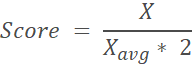
Next, indicators were grouped into thematic sub-parameters, their scores were calculated by summing equally weighted indicators, and the six key parameter scores (each maximum 10) were derived by summing equally weighted sub-parameters.
The Total Country Score (maximum 60) is the sum of the scores of the six parameters: Public Adoption, Infrastructure Adoption, Innovation and Technology, Regulatory Environment, Economic Factors, and Tax-Friendliness.
Methodology Changes
This year we have made several refinements to our methodology.
Crypto Users Estimation
To address gaps in data availability, we introduced a standardized estimation method for the Crypto Users metric sub-parameter for countries without reported figures (namely, Antigua and Barbuda, Grenada, Monaco, and St. Kitts and Nevis) by applying the regional average adoption rate (percentage of population) to their national populations. This provided consistent estimates for both absolute numbers of users and percentage adoption rates.
Global Benchmarking
To improve comparability and minimize distortions by outliers, we introduced global benchmark scaling for selected metrics.
For each benchmarked metric:
- The global average is set to 0.5 (or the dataset average if global figures are not available).
- A maximum score of 1.0 is assigned when a country’s value is at least twice the global average.
- A score of 0 is assigned if the metric is absent (for example, no government-approved projects, no exchanges, or no internet access).
- Intermediate values are scaled linearly between these points.
The formula applied is:
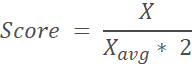
where X is the country’s value for any metric from the list below,  is the global or dataset average.
This approach ensures that countries performing around the global average are scored consistently, while extreme outliers are capped to maintain fairness across the index.
Metrics using global benchmarks:
|
Metric |
Benchmark Value (X_avg) |
Source/Basis |
|
Crypto Users Relative to Total Population, % |
3.23% |
Global average |
|
Crypto Users, Absolute |
6,072,809 |
Global average |
|
Number of Government-Backed Blockchain or Cryptocurrency Projects |
4 |
Dataset average |
|
Google Searches ‘Cryptocurrency’ and the Like for the Last Year |
15 |
Global average |
|
Cellular Subscription, % |
108% |
Global average |
|
Broadband Speed |
107.6% |
Global average |
|
Internet Penetration |
70.6% |
Global average |
|
Number of Cryptocurrency Exchanges in the List of Trusted Platforms |
4 |
Dataset average |
Data Sources
Public Adoption
The Public Adoption score is calculated as the sum of the following indicators, equally weighted:
- Share of Population Using Crypto: calculated as the average of the country’s number of crypto owners in absolute terms and crypto owners relative to total population, in percentage. Source: TripleA
- Public Interest: interest over time. Source: Google Trends
Infrastructure Adoption
The Infrastructure Adoption score is calculated as the sum of the following indicators, equally weighted:
- Crypto ATM Availability: the number of crypto ATMs present in the country, per square kilometer. Sources: Coin ATM Radar, Statista, World Bank
- Bank Integration: calculated as the sum of the following metrics, equally weighted, for each country:
- Exchange Presence: calculated as the sum of the following metrics, equally weighted, for each country:
- Merchant Adoption: calculated as the average of the number and density per square kilometer of businesses accepting cryptocurrency as payment. Sources: Bitcoin.com Maps, World Bank
Innovation and Technology
The Innovation and Technology score is calculated as the sum of the following indicators, equally weighted:
- Government Projects: approximate number of current government-backed blockchain or cryptocurrency projects. Sources: AlphaPoint, Bank of Canada, Digital Economy Council of Australia, Eastern Caribbean Central Bank, EU Blockchain Observatory and Forum, Malta Digital Innovation Authority, Office of Public Affairs – U.S. Department of Justice, Official Portal of the Grand Duchy of Luxembourg, Official Portal of the UAE, Remitano, Singapore Blockchain Innovation Programme
- Start-Ups & Companies: Number and density per square kilometer of cryptocurrency-related startups. Sources: Crunchbase, Linkedin, World Bank
Regulatory Environment
The Regulatory Environment score is calculated as the sum of the following indicators, equally weighted:
- Initial Coin Offering (ICO) and Token Sales Regulation: assessment of whether ICOs are allowed and regulated. Sources: Australian Securities and Investments Commission, Austrian Financial Market Authority, Bitcoin Market Journal, Canadian Securities Administrators, Crypto Asset Services Providers, ECCB Advisory, Financial Markets Authority – Te Mana Tātai Hokohoko, Ministry of Legal Affairs – Antigua and Barbuda, Monetary Authority of Singapore (MAS), National Securities and Exchange Commission of Spain, Securities and Futures Commission, Tálosi&Tálosi Attorneys, TechFinitive, Tilleke & Gibbins
- Central-Bank-Backed Digital Currencies: availability and state of government-backed digital currency projects. Sources: Atlantic Council, Bank of England
- Legal Environment: calculated as the sum of the following metrics, equally weighted, for each country:
- Is crypto accepted as legal tender? Sources: BBC, Central Banking, Coredo, Daily Sabah, European Parliament, Financial Services Commission Mauritius, Global Legal Insights, Government of Canada, Library of Congress, Mondaq, PwC
- Presence of regulatory sandboxes for crypto/fintech. Sources: American Banker, Cointelegraph, Daily Sabah, Eastern Caribbean Securities Regulatory Commission, Government Information Service Mauritius, Hong Kong Monetary Authority, Law Office Malaysia, Legalink, PwC
- Regulatory Clarity: calculated as the sum of the following metrics, equally weighted, for each country:
- Regulatory aggressiveness. Sources: Daily Sabah, European Parliament, Forbes, Library of Congress, NTL Trust, PwC, The Caribbean Views, WeirFoulds LLP
- Clarity of Regulations. Sources: Daily Sabah, European Parliament, International Organization of Securities Commissions, OECD, PwC
Economic Factors
The Economic Factors score is calculated as the sum of the following indicators, equally weighted:
- Financial Inclusion: Percentage of the population with access to banking. Source: World Bank
- Internet and Smartphone Penetration: calculated as the sum of the following metrics, equally weighted, for each country:
Tax-Friendliness
The Tax-Friendliness score is calculated as the sum of the following indicators, equally weighted: Capital gains taxes and Income taxes. Sources: Australian Taxation Office, EY, Financial Times, Freeman Law, Government of Canada, Government of the United Kingdom, Inland Revenue Board of Malaysia, IRS, Ministry of Finance – Republic of Cyprus, Ministry of Legal Affairs – Antigua and Barbuda, OECD Global Forum on Transparency and Exchange of Information for Tax Purposes, Regulated United Europe, PwC, Simmons & Simmons, Wyden
link