
AI Use is Widespread, But Concern Is Rising Among Canadians

Vast majority concerned about AI’s impacts on misinformation, job loss, privacy, inequality, energy use
November 20, 2025 – Artificial intelligence has been a rocket ship for investment in 2025, sending Wall Street soaring and contributing by some estimates to 40 per cent of GDP growth south of the border as spending on datacentres and development booms. As Canadians watch and experience the ways that AI is changing their lives, perspectives are defined by hesitation, concern, and pockets of optimism.
New data from the non-profit Angus Reid Institute – collected, analyzed, and summarized by human beings – finds adoption of this transformative technology uneven. Age, education and wealth correlate with uptake. While younger people adopting technology at a faster pace may not surprise many, the income gap is far wider and more revelatory.
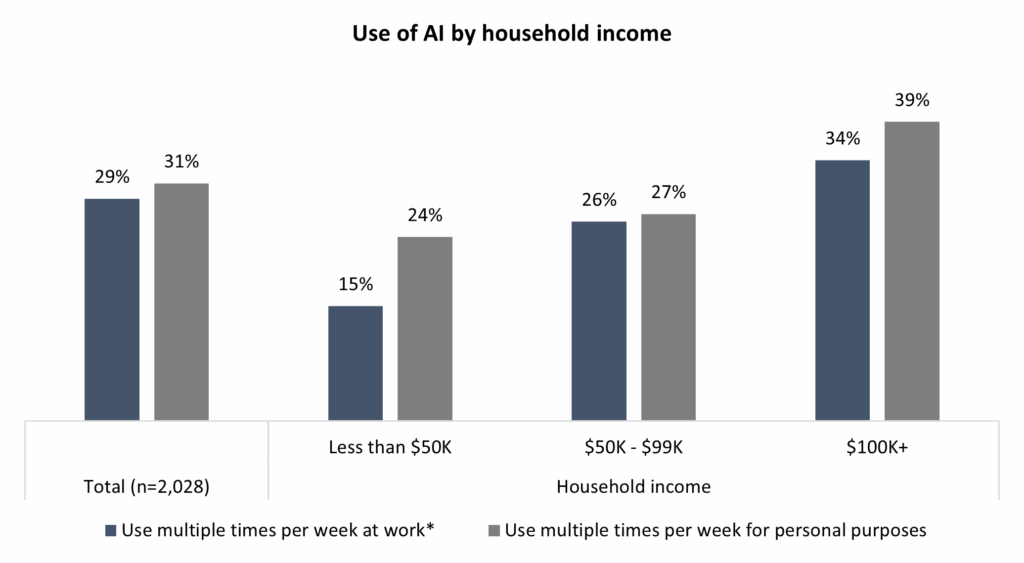
Consider that those who household incomes are higher than $100,000 are far more likely to use AI multiple times per week for personal reasons (39%) compared to those in the $50K to $99K range (27%) and below $50K (24%). Use at work produces an even larger but perhaps more obvious gap, given the lack on need in some industries and the growing dependence in others.
While it is likely too early to make any generalizations about this trend, it is worth nothing that four-in-five Canadians (78%) say that AI will create a prosperity gap between those who comfortable with using the technology and those who are not.
There is more consensus on some of the challenges and negative consequences they expect from AI. Just three-in-10 (31%) say that it will make life easier for everyone, while more than twice as many (69%) disagree. On the concept of job losses – something already happening at tech firms – Canadians are overwhelmingly view AI’s net effects to include job loss (86%) not job creation (14%).
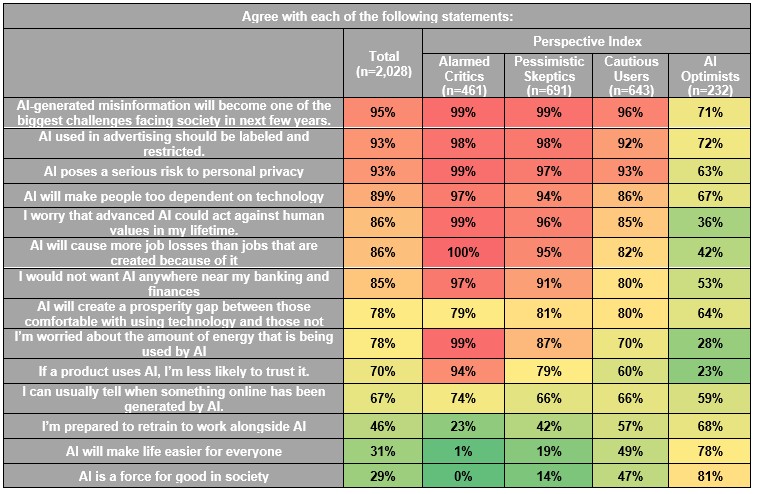
Further, 95 per cent say that AI related misinformation will become a major challenge for society in the coming years and four-in-five (78%) are worried about the amount of energy this new technology utilizes.
More Key Findings:
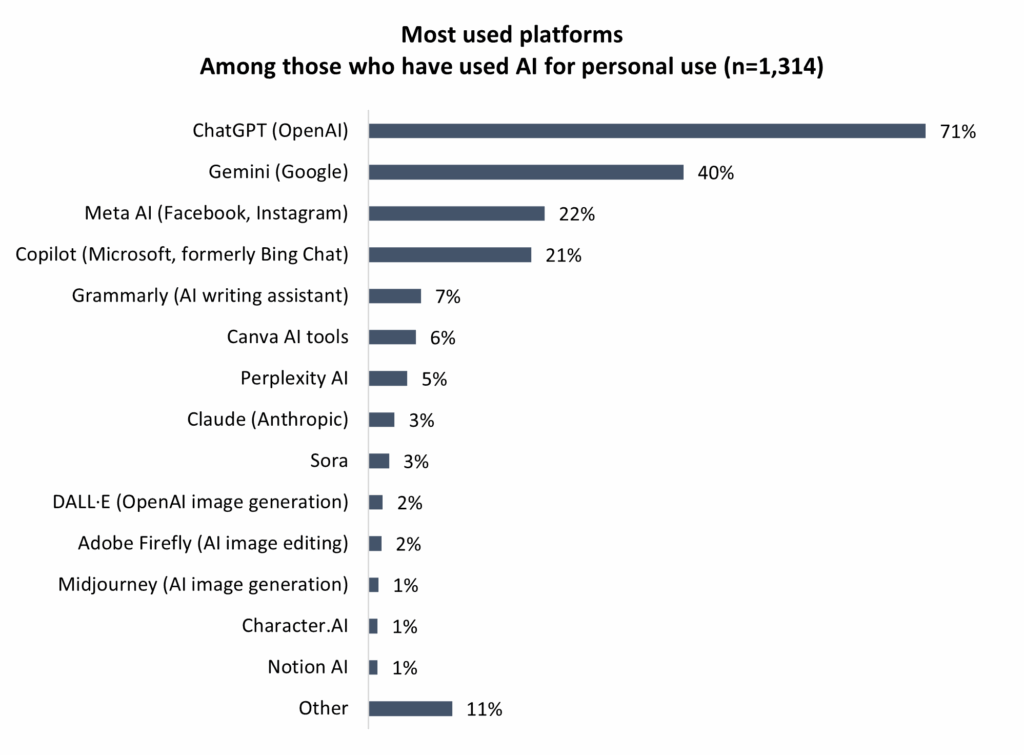
- Asked which platforms they’re using, ChatGPT dominates the landscape. Seven-in-10 (71%) AI users have utilized it, compared to 40 per cent for Google Gemini and 22 per cent for Meta AI, and 21 per cent for Microsoft’s Copilot.
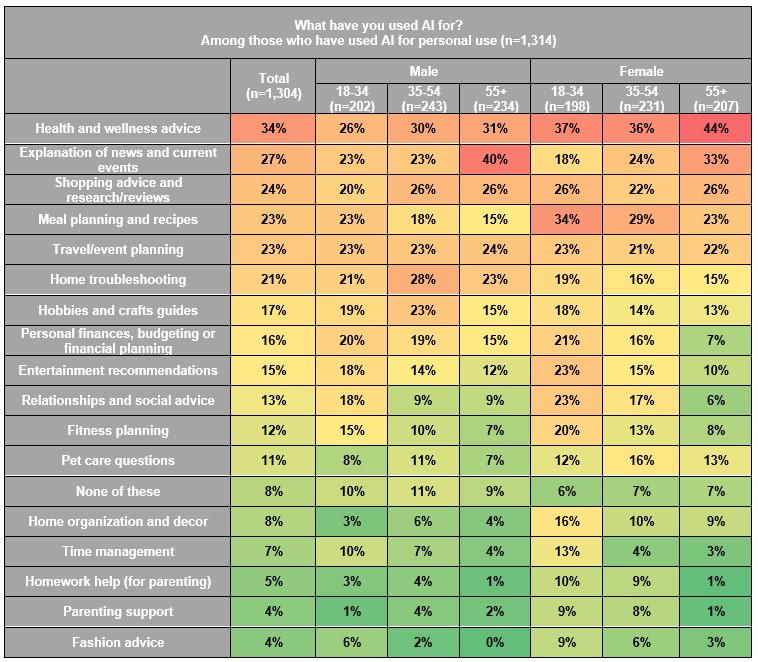
- Personal uses of AI vary widely by age and gender, with health and wellness, news, shopping and purchasing research, meal planning, and travel, all used by more than one-in-five overall
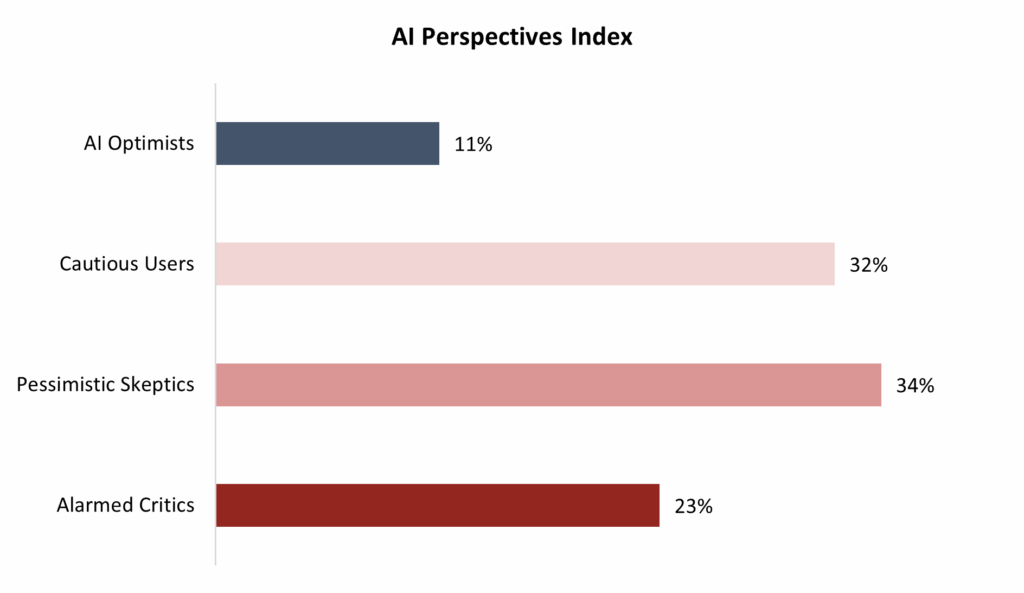
- Measuring a number of responses about the potential good and bad impacts of AI, Angus Reid Institute developed a spectrum of perspectives. Only one-in-10 Canadians (11%) are genuinely AI Optimists, seeing far more benefit than potential risk. One-in-three (32%) are Cautious Users, or Pessimistic Skeptics (34%). One-quarter are Alarmed Critics (23%) perceiving nearly all risk and no value.
INDEX
Part One: Views of an emerging technology
-
Familiarity
-
Personal use
-
A generation gap in adoption
Part Two: What AI are Canadians using and what for?
-
Chat GPT is king, for now
-
Uses vary widely across the population
-
Trust is an issue
Part Three: Alarmed Critics, AI Optimists, and others
-
Perspectives on impact and the future
-
For now, concerns vastly outstrip benefits
Part One: Views of an emerging technology
Artificial intelligence has been with us for decades, but the acceleration and application of the concept has hit home for many since the launch of ChatGPT in November 2022. Since then, a cascade of integrations and offerings have hit users, and billions have been invested by firms in the hopes of capitalizing on early adoption. Included in this is the Canadian federal government, whose 2025 budget allocates a billion dollars to boost Canadian AI and modernize how the government engages with the technology.
The disruptive technology either threatens to, or offers the hope to, change the world as we know it – depending on who one asks.
Familiarity
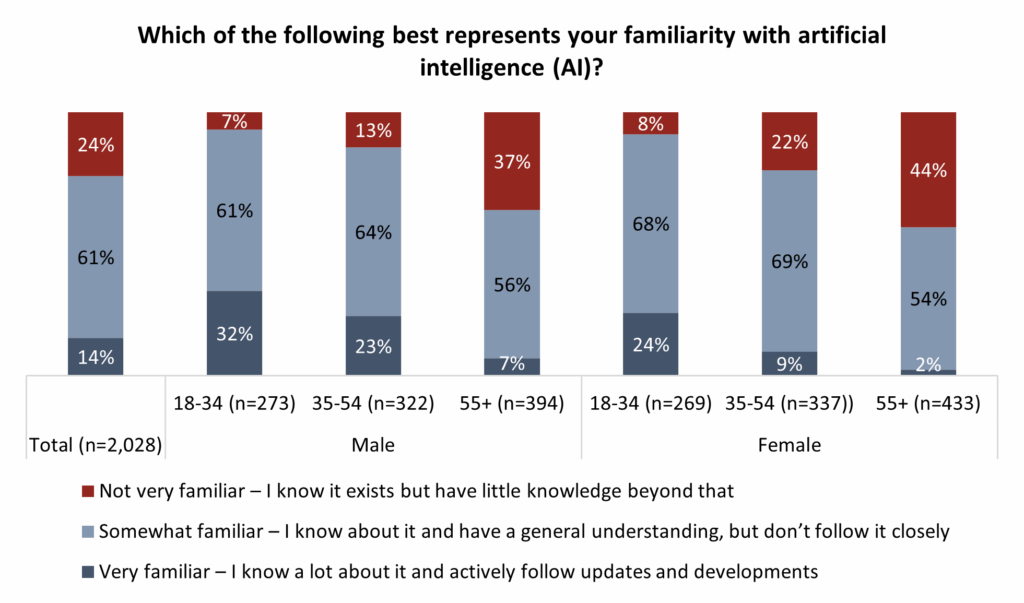
For the bulk of the Canadian population, AI is still somewhat of a vague notion. Three-in-five say they’re somewhat familiar with the term. Others occupy a more extreme position with regard to awareness, either saying they’re not very familiar (24%) or very familiar (14%). Notably, young people more than old and men more than women express more familiarity:
Personal use
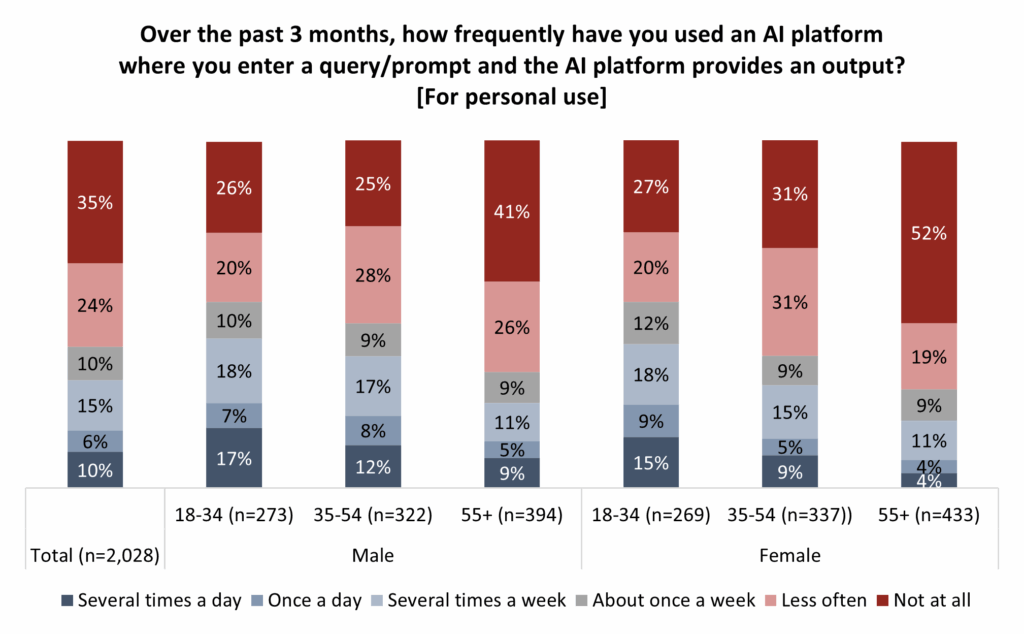
Those same demographic trends apply to use on both a personal and work level. Asked if they have used an AI platform in their own life outside of work over the past three months, 35 per cent say not at all – rising to 41 per cent and 52 per cent respectively more men and women over 54 years of age. Young men and women are equally likely to have done this daily (24%%:
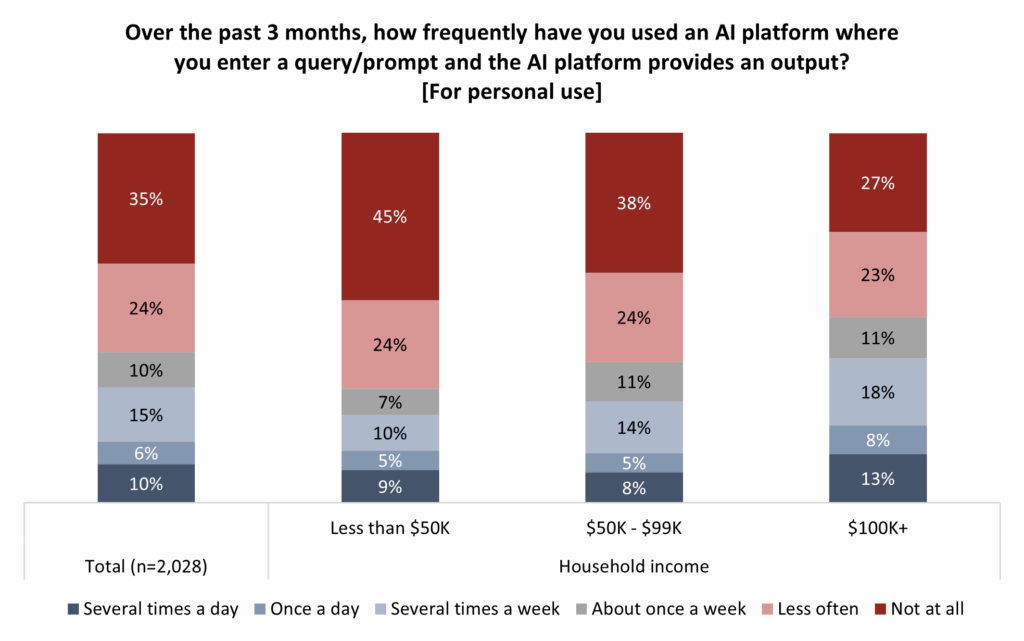
One of the other key indicators alongside age and gender appears to be income level. Approaching half of lower-income Canadians (45%) have not used AI at all in the past three months, 18-points higher than those with incomes over $100,000. Daily use in this higher income group reaches one-in-five (21%):
A generation gap in adoption
The profile of adoption looks similar for work use (see detailed tables at end of release) though in general Canadians are using AI more for personal purposes than when they’re on the job. Much of this may have to do with the lack of an application for AI in certain blue-collar fields with a manual work component.
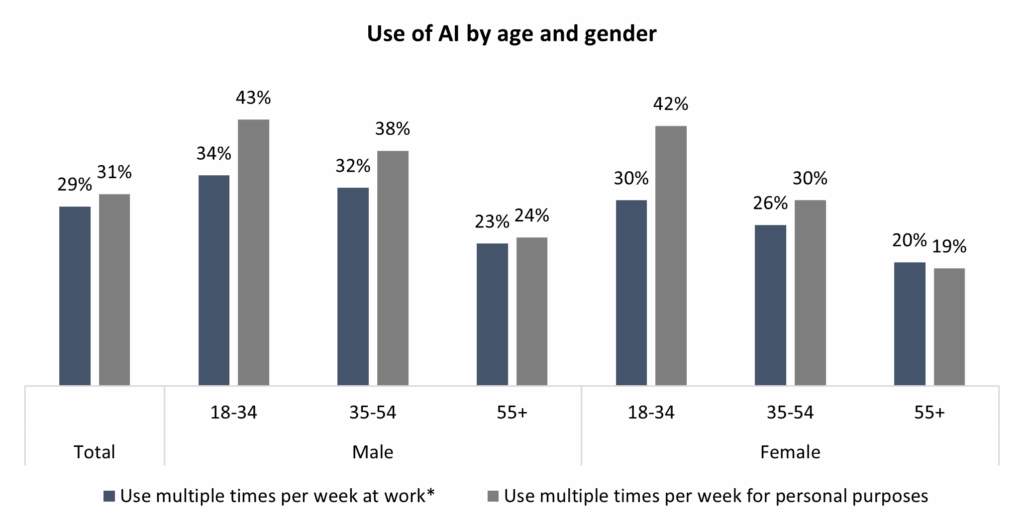
*asked only of those currently employed
Income is again a massive correlating factor with work usage of AI, even more so than for personal use:
*asked only of those currently employed
Part Two: What AI are Canadians using and what for?
Chat GPT is king, for now
AI offerings continue to proliferate, with tens of thousands of companies fighting for space in a competitive industry. Capabilities and specializations differ, but for the average person, Open AI’s ChatGPT has much of the market cornered. That company was valued at $500 billion in October after beginning as a non-profit organization. Seven-in-10 Canadian AI users (over the past three months) say ChatGPT has been one of their platforms of choice. This nearly doubles Google’s Large Language Model (LLM) Gemini, chosen by 40 per cent. Other tech heavyweights are used by one-in-five, including Meta AI and Microsoft Co-Pilot.
Uses vary widely across the population
LLMs provide a significant breadth of capability as assistants, analysts, planners, and searchers. The top use for Canadian AI users is health and wellness advice, used by more among women than men. Men over the age of 54 are most likely to use AI for news and current events summary or analysis. Women younger than 55 show a heightened preference for meal planning and recipes. Across the age and gender spectrum there are clear preferences that show the variation in application:
Trust is an issue
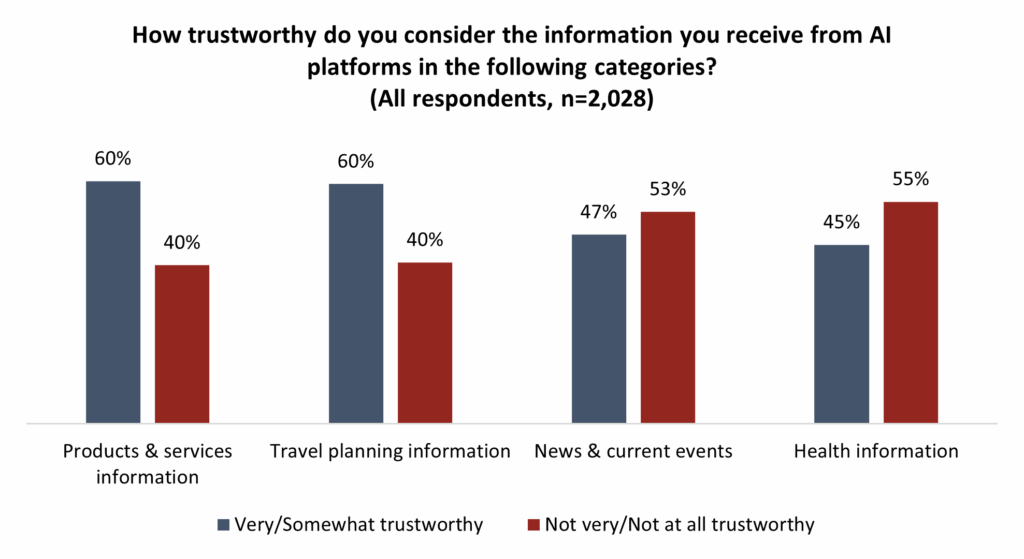
Not everyone, however, is fully trusting of the information that they receive back from AI platforms. While a majority of Canadians say they trust information about products and services as well as travel planning, the opposite is true when it comes to current events and information about health matters:
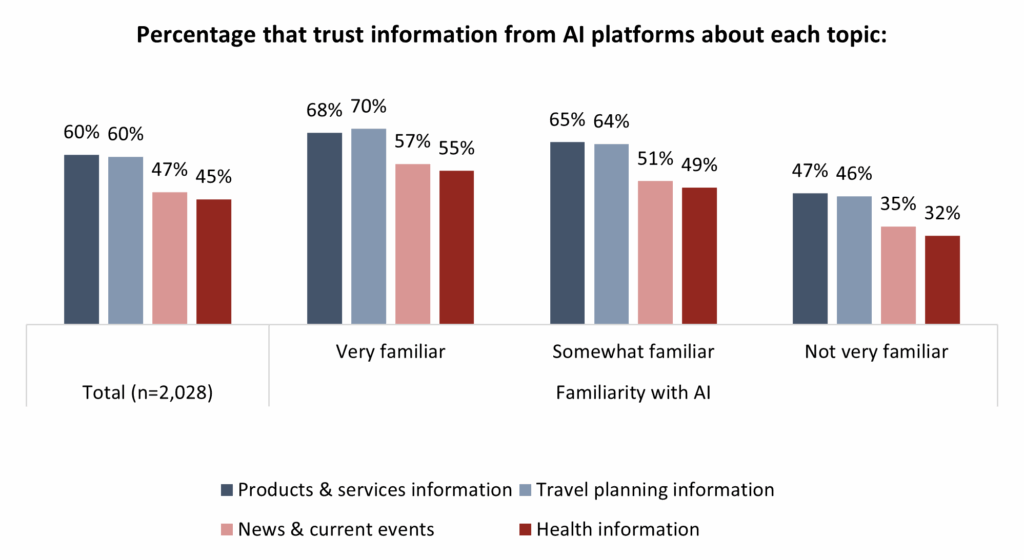
It’s not just those who are unfamiliar with AI who lack trust. Those who say they’re very familiar are far from comfortable, with at least three-in-10 mistrustful of all four potential areas of information:
Part Three: Alarmed Critics, AI Optimists, and others
AI is here and evolving rapidly, and Canadians clearly have varying perspectives on what this will mean for society in the future. Using responses from a group of positive and negative statements, Angus Reid Institute created an AI Perspectives Index. See the questions and scoring here.
Perspectives on impact and the future
The overall landscape is defined by hesitation if not outright pessimism about the broad impacts of AI on society. Below are the four groups and their sizes, with more information about their views to follow:
AI Optimists are found in every age and gender combination, but notably they’re more likely to be men than women in every age group – particularly over the age of 54. They’re also the smallest group in every category. Skepticism and pessimism are far more prominent. Even among young men, the most likely to be using AI, the majority are either Alarmed Critics or Pessimistic Skeptics:
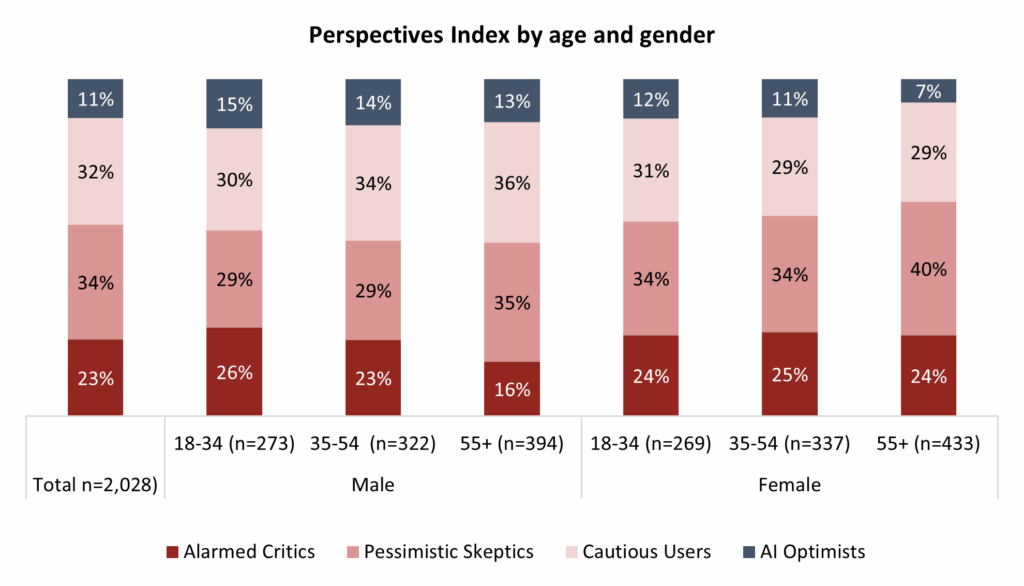
There is also a significant correlation with income on the Perspectives Index. The proportion of AI Optimists in the upper income bracket is double that of the lowest (15% vs 8%). See detailed tables for more information.
For now, concerns vastly outstrip benefits
The most critical group – the Alarmed Critics (23%) – are near unanimous in their views that the costs are going to dwarf the benefits from the job market, to misinformation, to energy consumption. That group is double the size of the most positive – the AI Optimists (11%). This group sees AI as a force for good and a benefit to the lives of users. They’re also far more trusting of the technology than others, though they do agree about key concerns like misinformation and privacy. Two similarly sized groups are the Pessimistic Skeptics (34%) and Cautious Users (32%). Both score negatively on the overall Perspective Index, but the Cautious aer more likely to perceive positive benefits, more likely to use the tech themselves, and are more willing to adopt AI at work.
METHODOLOGY
The Angus Reid Institute conducted an online survey from October 24 – 29 2025, among a randomized sample of 2,028 Canadian adults who are members of Angus Reid Forum. The sample was weighted to be representative of adults nationwide according to region, gender, age, household income, and education, based on the Canadian census. For comparison purposes only, a probability sample of this size would carry a margin of error of +/- 1.5 percentage points, 19 times out of 20. Discrepancies in or between totals are due to rounding. The survey was self-commissioned and paid for by ARI. Detailed tables are found at the end of this release.
How we poll
For detailed results by age, gender, region, education, and other demographics, click here.
For detailed results by AI Perspectives Index, click here.
For PDF of full release, click here.
For questionnaire, click here.
MEDIA CONTACTS:
Shachi Kurl, President: 604.908.1693 [email protected] @shachikurl
Dave Korzinski, Research Director: 250.899.0821 [email protected]
link