
Vietnam Fintech Market Size, and Growth Report, 2032
Key Highlights
| Study Period | 2021 – 2032 |
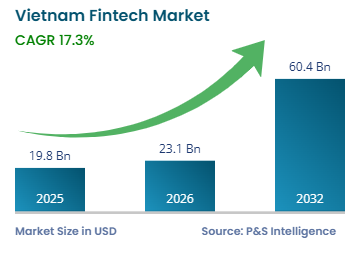
| Market Size in 2025 | USD 19.8 Billion |
| Market Size in 2026 | USD 23.1 Billion |
| Market Size by 2032 | USD 60.4 Billion |
| Projected CAGR | 17.3% |
| Largest Province | Ho Chi Minh |
| Fastest-Growing Province | Hanoi |
| Market Structure | Moderately Fragmented |
Market Size
Explore the market potential with our data-driven report
Vietnam Fintech Market Outlook
The Vietnamese fintech market values USD 19.8 billion in 2025, and it is projected to grow at a CAGR of 17.3% during 2026–2032, reaching USD 60.4 billion by 2032. The market’s growth trajectory reflects Vietnam’s accelerating digital transformation and the increasing adoption of technology-driven financial services across all segments of the population. The convergence of favorable demographics, rising smartphone penetration, and supportive government policies has positioned Vietnam as one of the most promising fintech markets in Southeast Asia.
A significant factor contributing to market expansion is the country’s large unbanked and underbanked population seeking accessible digital financial solutions. According to the State Bank of Vietnam, over 77% of adults now hold bank accounts, marking substantial progress in financial inclusion efforts. However, the remaining underbanked population represents a considerable opportunity for fintech companies offering mobile payments, digital lending, and alternative financial services. The proliferation of e-wallets and mobile payment applications has been particularly transformative.
Vietnam Fintech Market Segmentation Analysis
Business Model Analysis
The B2C category holds the largest share, of 50%, driven by the proliferation of consumer-facing applications, including neobanks, retail payment platforms, and personal finance solutions. The rise of digital wallets has been particularly significant, while neobanks have gained substantial traction by offering seamless mobile banking experiences, competitive interest rates, and user-friendly interfaces. These features appeal to digitally native consumers seeking alternatives to traditional banking services.
The marketplace category is expected to register the fastest growth during the forecast period, with a CAGR of 14.7%. P2P lending platforms and crowdfunding solutions are addressing the significant financing gap faced by small and medium enterprises, with unfilled SME financing needs estimated by the International Finance Corporation at approximately VND 500 trillion (USD 21 billion). Tima, VayMuon, and Growth Wealth are leveraging technology to connect borrowers with investors, providing credit access outside traditional banking channels.
These business models are covered:
- B2C (Largest Category)
- Neobanks
- Retail Payment
- Others
- B2B
- Payments Infrastructure
- Banking-as-a-Service
- Others
- B2B2C
- Fintech Companies
- White-Label Platforms
- Others
- Marketplace (Fastest-Growing Category)
- P2P Lending
- Crowdfunding Platforms
- Others
Technology Analysis
The API technology dominates the market with 40% share. APIs serve as the foundational infrastructure enabling seamless integration between fintech applications, banking systems, and third-party services. The issuance of Circular 64/2024/TT-NHNN by the State Bank of Vietnam, regulating Open API implementation in the banking sector, has formalized standards for data sharing and interoperability among commercial banks and their affiliated entities. VNPay’s payment ecosystem connects over 40 banks and serves more than 40 million customers through partner mobile banking applications.
AI is projected to exhibit the fastest growth during the forecast period, with a CAGR of 17.5%. AI usage in fraud detection, customer service automation, credit risk assessment, and personalized financial advisory is surging across Vietnam’s fintech landscape to enhance customer acquisition, optimize marketing, and improve operational efficiency. The emergence of AI-driven credit scoring systems for digital lending enables fintech companies to serve financially excluded populations through alternative data analysis.
These technologies are covered:
- Application Programming Interface (API) (Largest Category)
- Artificial Intelligence (AI) (Fastest-Growing Category)
- Blockchain
- Robotic Process Automation (RPA)
- Data Analytics
- Others
Deployment Mode Analysis
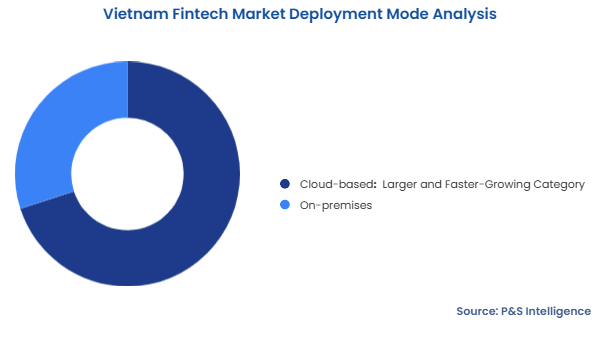
Cloud-based deployment holds the larger market share, of 70%, and it also has the higher CAGR. The preference for cloud infrastructure stems from its scalability, cost efficiency, and ability to support rapid service expansion across geographically dispersed user bases. Cloud deployment enables fintech companies to handle transaction volume fluctuations, particularly during peak periods, such as the Lunar New Year and major e-commerce events. Major technology providers offer localized services that comply with data sovereignty requirements, while providing enterprise-grade security and reliability in Vietnam.
This category is also driven by the increasing digitalization of financial services and the expansion of fintech operations to underserved markets. Fintech startups particularly favor cloud deployment due to lower initial capital requirements and the flexibility to scale operations as customer bases expand. The growing confidence in cloud security protocols and the availability of robust local data center infrastructure continue to accelerate adoption across both established financial institutions and emerging fintech players.
These deployment modes are covered:
- Cloud-based (Larger and Faster-Growing Category)
- On-premises
Application Analysis
Payment & funds transfer applications command the largest share of the Vietnamese fintech market in 2025, of 45%, as digital payment solutions have achieved widespread adoption among Vietnamese consumers. The NAPAS 247 instant transfer system handled 8.9 billion transactions in 2024, 33.8% more than last year. The partnership between Visa and the e-wallets MoMo, VNPay, and ZaloPay enables Visa cardholders to make QR-based payments at participating merchants nationwide.
Digital lending is the fastest-growing category during the forecast period, with a CAGR of 17.6%. This is credited to the substantial demand for credit among small businesses and individuals underserved by traditional banking institutions. Buy now, pay later solutions have gained significant traction as they enable e-commerce consumers to access short-term financing for online purchases. The regulatory sandbox provisions for P2P lending are expected to unlock substantial growth potential by providing a clear legal framework for digital lending platforms to operate and scale their services.
These application segments are covered:
- Payment & Funds Transfer (Largest Category)
- Digital Lending (Fastest-Growing Category)
- Insurance
- Wealth Management
- Personal Finance
- Others
End User Analysis
The Banking sector dominates the market with 50% share. Commercial banks have been at the forefront of fintech adoption, partnering with technology companies to modernize their service delivery and enhance customer experiences. Major banks have invested substantially in digital banking platforms, mobile applications, and API integrations with fintech providers. VNLife’s cashless payment network provides white-label solutions for banks, with its QR code systems deployed at over 600,000 point-of-sale terminals nationwide.
Insurance companies are expected to exhibit the fastest growth, driven by the rising demand for streamlined policy distribution, claims processing, and customer engagement. Insurtech companies are leveraging AI for tailored insurance recommendations and automated underwriting processes. The regulatory framework now permits insurance enterprises to issue electronic certificates for compulsory motor vehicle liability insurance, facilitating digital distribution channels. The relatively low insurance penetration, growing middle class, and increasing awareness of risk protection present opportunities for insurtech solutions in Vietnam.
These end users are covered:
- Banking (Largest Category)
- Insurance Companies (Fastest-Growing Category)
- Investment Firms
- Others
Drive strategic growth with comprehensive market analysis
Vietnam Fintech Market Geographical Analysis
Ho Chi Minh Fintech Market Size
Ho Chi Minh holds the largest share, of 40%. The city serves as Vietnam’s commercial and financial capital, hosting more than 2,000 technology startups. Major local fintech companies maintain their headquarters in Ho Chi Minh City, benefiting from access to venture capital, skilled technology talent, and a large consumer base with high digital literacy. The concentration of established banks, financial institutions, and multinational corporations creates a favorable environment for fintech innovation and partnership opportunities.
The establishment of Vietnam’s International Financial Centre in Ho Chi Minh City is expected to further solidify the city’s position as the nation’s fintech hub. According to the Ho Chi Minh City Department of Science and Technology, the city has achieved 82% 5G coverage and operates 16 data centers, providing robust digital infrastructure for financial technology operations. The development of a ‘fintech superhighway’ linking Vietnam and Singapore demonstrates a strategic intent to position Ho Chi Minh City as a regional leader in digital finance.
Hanoi Fintech Market Growth
Hanoi is expected to be the fastest-growing provincial market during the forecast period, with a CAGR of 17.4%. As Vietnam’s capital and political center, Hanoi has emerged as an important secondary hub for fintech development, particularly in blockchain, digital banking, and enterprise financial solutions. Numerous major companies are headquartered in Hanoi, contributing to the city’s growing significance in the fintech landscape. The Hanoi government’s pilot program for mobile payments in rural areas has accelerated digital payment adoption among underserved communities in the surrounding Red River Delta provinces.
The Vietnam National University and Hanoi University of Science and Technology in Hanoi supply skilled technology talent to the fintech sector. The Vietnam National Innovation Centre targets to develop at least five unicorns by 2030, with Hanoi expected to play a significant role in achieving this objective. The city’s fintech ecosystem is particularly strong in B2B solutions, payments infrastructure, and blockchain applications, complementing Ho Chi Minh City’s strength in consumer-facing fintech services. Rising digital payment adoption among Hanoi’s population of over 8 million residents presents substantial growth opportunities for both established players and emerging startups.
These provinces are covered:
- Ho Chi Minh (Largest Market)
- Hanoi (Fastest-Growing Market)
- Da Nang
- Hai Phong
- Can Tho
- Binh Duong
- Dong Nai
- Khanh Hoa
- Quang Ninh
- Rest of Vietnam
Vietnam Fintech Market Share
The Vietnamese fintech market exhibits a moderately fragmented competitive landscape, characterized by the presence of domestic unicorns, established technology companies, and numerous emerging startups across various segments. While the digital payment category has seen consolidation around major players, insurtech and wealth management remain highly competitive with multiple players. Strategic partnerships and product diversification have emerged as key competitive strategies in the market. Foreign investors continue to recognize Vietnam’s fintech potential, with notable investments, expanding operations with over USD 70 million in SME financing.
Key Vietnam Fintech Companies:
- M_Service Joint Stock Company
- VNLIFE Joint Stock Company
- VNG Corporation
- Vietnam Prosperity Joint Stock Commercial Bank
- Saha Group Joint Stock Company
- Tima Joint Stock Company
- Sky Mavis Pte. Ltd.
- Grab Holdings Limited
- Military Industry and Telecommunications Group
- Trusting Social Group
- Sea Group Ltd.
link